How to Know if you are Experiencing Intuition or Delusion?

Intuition is an extrasensory sense–proven recently as one of our secondary senses–that acts as an inner-guidance system. Intuition can come across in a variety of different ways from feelings to senses and knowings to hunches to even moments of clairvoyance where a message or miraculous thought is delivered. While intuition cannot be proven scientifically yet, many people have experienced some profound intuitive experiences that act as their own proof that intuition exists. A lot of times, we cannot prove intuition ourselves until after the fact, when we reflect on a message we received. It is oftentimes this reflecting and looking back that confirms for us that what we experienced was in fact intuition.

Here are some ways that you can look for intuition in your own life. 

FEELINGS, SENSES & HUNCHES

Have you ever had a feeling about something? You really couldn’t explain it, but that feeling acted as a warning or a nudging in some way to inform you to act in some way. Maybe it was a warning feeling like the person you were with was not safe or that you should remove yourself from an environment? Maybe you were in a public place and you got a funny feeling that something might happen and you felt impressed to leave only to learn later that a catastrophic event transpired (many people who were schedule to be on a 9/11 flight or go to the World Trade Center that day experienced this). At the time you get the feeling, you aren’t sure if it’s fear or paranoia and a part of you wants to ignore the fear and paranoia as not to seem crazy, but a bigger part of you (the intuitive part) cannot deny the hunch and so you listen and later discover what the hunch was all about. These are all examples of feeling, sense and hunch intuitions. The more that we become sensitive to our body sensations, feelings and senses, the easier it will be to discern between what is fear and what is intuition. If we experience the same fears again and again, but nothing happens, it is likely that we have anxiety in a particular area in our lives. This is not to say that one time our fear won’t turn out to be intuition. With intuition, the feeling or sense comes and immediately after the confirmation comes to justify that we experienced intuition. Some feeling experiences are subtle, while others are more obvious. Some feelings simply guide us in the direction of a particular choice while others protect us. Feelings can also have to do with our physical bodies and intuitive senses and feelings that something is not right. This can ring true even after doctors have ruled out sickness. Numerous individuals have reported stage 4 cancer diagnoses years after first reporting symptoms and hunches to their doctors. 

IMPRESSIONS

Another way that we may experience intuition is through impressions. Maybe we go to a job interview or view an open house. While we cannot put words to our experience or prove it at the time, we feel an impression telling us something is not right and that it is best for us to choose a different job or home. While impressions are feelings, the difference between an impression and a feeling intuition is that with feeling intuitive experiences, it’s more instantaneous whereas an impression intuitive experience is more collective. As we embark on the interview or house viewing, our intuitive experience grows and we become more and more informed that this is not the right choice for us. An example of an impression would be, let’s say that I go to an open house and while viewing the grounds, my eyes pause on the chimney. I get a funny feeling about the chimney. While the listing says nothing about a chimney issue, this feeling I am experiencing is causing my intuition to become heightened–my intuition is telling me there is a chimney issue. Still I love the house. In spite of my impression, I decide that an inspection will be performed and if there is an issue, the inspector will surely tell me. To my surprise the inspector says nothing about the chimney. I conclude that I must be wrong and sign on the dotted line and forget all about my impression. But months later, weird things start happening. The fireplace starts leaking. The basement chimney clean outs start to leak and little by little my intuitive experience is remembered. It is through each new chimney issue that I collect clues until finally it becomes undeniable that my intuition was reliable and spot on. It started with an impression and ended with confirmation. 

RANDOM THOUGHTS

Have you ever had random thoughts pop in your head? Maybe you were working on a homework assignment about the Civil War or building a lego set and suddenly this random thought pops in your head to call grandma. It comes out of nowhere and you cannot make head’s or tails of it. Once you pick up the phone and call grandma, you find her in distress and in need of immediate support. Random thoughts are an example of intuition in that our mind and body are connected to the universe at large and the universe has its own communication system that is invisible and while we cannot see it, this messaging system is always working and sending messages from one of us to the next. When we are sensitive to it and listen to the thoughts, we can begin to gain insight into another way that intuition comes. A really great way to know if its intuition is there is often proof following a random thought, feeling, hunch, etc. In addition to us receiving random thoughts, others might receive them about us and we may experience an unexpected call from someone who is exactly who we needed to hear from and they have no idea why they felt impressed to call us or maybe we bump into someone who happens to be the exact person we needed to bump into, etc. This is intuition happening to us in reverse. 

KNOWINGS AND MESSAGES

Another way that we can experience intuition is through knowings and messages. Let’s say that we are sitting with a friend or family member having a conversation about a particular person. Our friend begins to tell us their friend’s story and circumstances. Then all of a sudden, like a flash, we get a message that warns that something bad is going to happen to them. At the time, we are taken aback by it, but it is not until days later when we hear of the bad thing that happened to them that we realize it was a message or knowing. While sometimes logic can play a role. Let’s say the person we are learning about is doing highly risky behavior such as using drugs or recklessly driving. Logic tells us that these are dangerous behaviors and so the likelihood of a reckless driving getting into a car accident become a lot greater. If we learn the person got into an accident after the fact, this may not be intuition, but simply the consequences of reckless behavior. Still, there are times when we cannot explain a knowing. Sadly, we do not usually respond to these experiences because we fear being deemed crazy, etc. and it is not until after the fact that we realize the message we received and then we often feel guilty. As we become more sensitive and gain greater understanding of intuition, we will become more and more confident in our abilities and can then respond. I have had a lot of these types of experiences and only now am I coming to terms with the consistency and reliability to the point that I am now willing to seek after ways to use my intuition to help others. Learning to trust intuition is a process. 

CONNECTIONS

Closely related to messages, connection are more of a stream of messages over time that we receive and when we reflect on the messages all together we begin to make connections about a particular situation and it is the connections that we have about the messages the influence our final decision. The chimney story is a great example of intuition connections. At first it was just an impression. With each new leak, it became undeniable that there was a problem. And each new problem leads itself to further investigate. And then, when professionals come in and try to persuade you away from what the true problem is, you can remember your impression and begin to connect all the dots and follow each stream of water to exactly where the problem is. Once we realize that we are being guided by our intuition, we can trust all the promptings that follow which are guiding us toward the exact source of the problem and the exact solution. Once we reach this level of trust in our intuition, we will never be alone again and we will always be guided to answers. 

DREAMS & VISIONS

While I have never experienced any intuitive experiences through dreams or visions, my mother shared of one that she used to get when she was a child. She said that when she was little she would get visited by an old lady who would appear at the bottom of her bed and who would inform her of the soon passing of a loved one or relative. Whomever this old woman told my mom would pass always passed within the week. Looking back, my mother believes that she was in a dream state when it happened and although she felt like she was awake seeing this woman at the end of her bed, she now believes that she was asleep seeing herself in bed talking to this woman. Another time, my mother said that she had a dream of lottery numbers that would come up. She did not believe in gambling so did not play them, but to gauge the accuracy of her dream she checked the numbers to discover that every one of them came up. Some people have reported seeing visions of a natural disaster, a miraculous event, etc. as well. Again, what stands out about these intuitive examples is the results that follow the feelings or intuitive experience. The deaths confirmed my mother’s dream experience. The lottery numbers coming out confirmed it. When someone predicts a miraculous event and then the event occurs, this person is often classified as psychic. 

MEDIUMISTIC EXPERIENCES

ESP, telepathy, precognition, sixth sense, clairvoyance, clairsentience, clairaudience, to name only a few are examples of mediumistic intuition or psychic abilities. We all have different extrasensory gifts. Some of us are open to them while others are not. Some of us experience them early in life and grow to believe in them and some of us never experience them, therefore don’t believe. Additionally, some of us believe that those who claim to experience them may have some kind of mental illness. Because intuition is subjective for the most part, it is difficult to prove in either direction. This article is not about proving or disproving intuition, rather just describing the various ways that intuition can be experienced. As a writer, I have had many mediumistic experiences. Mozart was known to describe similar experiences where it was almost like he was being delivered the music and he was simply acting as the scribe. While I do not have the same experience, when I was working on my novel, there were many times when I would scribe down information onto the page of which I had no knowledge whatsoever. I was working on a sci-fi novel so a lot of the scientific stuff was not information I was privy to. After scribing I would go back and read it and conclude that I had no knowledge of any of that info then go and research it to check its validity only to discover it completely valid. Now there are all kinds of theory about our subconscious mind and its intelligence, etc. Is this experience intuition or a subconscious accessing? I do not know. I only know that we can have moments of scent intuition where through our noses we can gain insight and perception we cannot explain. Clairaudience where we hear an inner-voice speaking to us and guiding us (many writers and creators have attested to experiencing this). And for some, who are reported to have clairvoyance, they can predict things, see into the future and have psychic abilities. 

DELUSION

There are so many variables that go into differentiating between intuition, delusion or something else. I am not a medical professional therefore really cannot talk to actual delusion diagnosis. The delusion I speak of here is more to do with us thinking something is true when in fact it has a viable explanation or can be proven with logic. For example, we have a knocking in our house that we are unable to locate. We follow after the knocking in hopes of finding where it is coming from. We always get close, but right when we think we’ve figured it out, the knocking stops. Then, next time we go seeking it out, the knocking takes us to a new location. We’ve had professionals in to help us and none can find the root cause. ”Maybe it’s ghosts?” my daughter said one night half joking. I believe that there is a root cause and that we will figure it out so if I were to simply jump to the conclusion that our house is haunted, I feel this would classify as an example of delusion. I am jumping to a conclusion before I have any kind of feedback to suggest otherwise. What is more, having a hunch it is a ghost without any proof to back this in my opinion is not intuition. 

EXTRASENSORY GIFT OR DEVELOPED INTUITION?

When I was younger, I believed in extrasensory gifts. I loved visiting psychics and was always in awe of their accuracy. (One psychic predicted my daughter!). As I’ve grown in spiritual development and increased my consciousness and extrasensory abilities, I lean more toward believing that intuition can be developed and that as we develop our intuition, we gain more and more extrasensory abilities. It is my belief that these abilities lie dormant in all of us and that there is a process we must go through to gain self-awareness, self-discovery, consciousness, etc. before we can awaken these abilities or develop the confidence and trust to rely on them regularly. It’s why the things taught in all the great spiritual books talk about a lot of these topics. And it’s why so many of these teachings were kept secret and hidden to the masses. Consider the Salem witches treatment in the 1600s! Anything that could not be explained, that went against the norm was attacked and punished and as such so much of the extrasensory wisdom was suppressed and became feared by the masses after witnessing what happened to those who embraced it. Now that our society has evolved I feel that more and more people are embracing the realness of these abilities and slowly we are increasing in individuals who are seeking after awakening these parts of themselves and learning about them. Do you believe in intuition? What intuitive experiences have you had?

Much Love!

How to Find Personal Freedom & Create the Life You Want

Did you know that the average family generating $200K per year is broke? How can this be? With the cost of living skyrocketing and basic needs like college education savings, emergency and retirement funding taking so much of our monthly incomes, it’s no wonder more and more people in our society are becoming mentally ill. The average financial advisor will advise its clients to put $1K into savings, save 3-6 months of one year’s salary, invest 10% of annual income into retirement and 5% of annual income into college savings for our children. When groceries are now costing more than mortgage payments and the mortgage interest rates are at 7% for first time home buyers, $200K is simply NOT enough cash flow to make ends meet! (And this is assuming you have no financial aid or credit card debt!) The average family is turning to “side hustles” just to make ends meet. What is more, they are trading their personal freedom, self-care and presence with loved ones to do all of this working and side hustling. Stick around and I’ll show you an example budget of a two parent/one child household, uncover the contradiction between our current mental health healing model and current economy model and finally illuminate an alternative solution that enables you to create your life by design and take back your personal freedom. 

The $201K Household Budget

Meet the Parkers. Jim and Eleanor live in Connecticut with their 12 year old daughter, Lucy and her two dogs, Theory and Einstein. Jim is a veteran high school teacher earning a cap salary of $102K. Eleanor is a pediatric nurse earning a cap salary of $99K. Lucy attends public middle school and is a competitive dog agility handler. One day Lucy hopes to become a dog behaviorist and make it onto the world team for agility. Her parents have decided that Lucy’s dog agility and dog training is essential for her future. 

The Parker Annual Expenses:

$201K-$40K (tax free for both retirement funds, family healthcare and Lucy’s college fund)

Leaving them $161K

After 15% taxes as joint filers they will have $136,850 plus the $40K tax free money to pay the following:

  1. Mortgage $15K
  2. Electricity $2400
  3. Heat/gas $2500
  4. Water/sewer $500
  5. Groceries/home needs $16K
  6. Car payment $4800
  7. Car insurance $2300
  8. Car taxes $600
  9. Car registration $100
  10. Car emissions $40
  11. Home insurance $1200
  12. Home taxes $5K
  13. Dog food $1800
  14. Dog treats $500
  15. Dog chews $400
  16. Dog supplements $500
  17. Dog agility training $8K
  18. Vet $3K
  19. Clothing $2K
  20. Holidays $5K
  21. Financial aid $4K
  22. Eleanor retirement $10K (pre-tax)
  23. Jim retirement $10K (pre-tax)
  24. Savings $10K
  25. Emergency fund $8K
  26. Home maintenance and repairs $8K
  27. Car repairs and maintenance $3500
  28. Healthcare $10K (pre-tax)
  29. Cell phones $1800
  30. Cable/internet $1800
  31. College savings for Lucy $10K (pre-tax) 
  32. iCloud $110
  33. Misc. subscriptions $250
  34. Eating out $3600
  35. Dog agility trials $10K
  36. Lucy summer camp $4K
  37. Tech support $500
  38. Dog grooming essentials $300
  39. Dog misc. (flea collars, etc.) $450
  40. Socialization/entertainment $2K

Leaving them with $6,900 for unforeseen and miscellaneous expenses. And as someone with their child in dog agility, I figured very low on above expenses. There are so many additional expenses that I did not even list here like travel expenses to competitions, dog chiropractics and seminars and other education and educational resources. 

What is so important about the above expenses is that both Jim and Eleanor have reached the highest salaries they can earn. What is more, both of them work over 40 hours per week leaving them little time to add a side hustle. Jim could add a side hustle in the summer, but to save money, he does most of the home repairs and maintenance himself and chooses to do these projects over the summer. 

A LOOK at the CURRENT MENTAL HEALTH HEALING MODEL & OUR CURRENT ECONOMY MODEL

In 1943, Abraham Maslow proposed a theory called The Hierarchy of Needs which was basically a pyramid listing in order human needs with safety and security anchoring the pyramid at the bottom and self-actualization at its peak. It was his belief that first we must get our physiological needs of water, shelter, clothing, etc. met followed by personal security, employment, healthcare, resources and then move up the ladder to love and belonging, esteem (respect, status, freedom) and finally self-actualization (or becoming the most that one can become). Our mental health system still uses this model today as its most valued form of human guidance. Our economy beliefs and system pretty much support this perspective as saving for a child’s education continues to be among the top advice given for future planning. And so, when we use Maslow’s hierarchy as a gauge, we can see very quickly that the majority of people in our society (including college graduates and professional people) are stuck in the bottom two tiers of this hierarchy. Rare is it to find people (and certainly young people) with status, esteem, and self-actualization. We often see those ready to retire finally reaching the “millionaire” mark and excited to finally “live freely” which is absolutely crazy to me because our current economic, education and mental health model is essentially encouraging people to plan for one’s future freedom by trading one’s current freedom for this system. And so it is that as society’s people attempt to climb the hierarchy while working 40+ hours and then tending to a home that they’ve mortgaged and caring for the children they are raising to follow this same path, it is no wonder that products like caffeine and aimless scrolling are among the top sellers and best business models. And because everyone is exhausted, there is no time to question the model or seek after another. Once the financial aid has been spent and the houses have been purchased and the debt is here, one becomes trapped in the 9-5 cycle to pay if off. But what if there was another way?

Healing has more ideas than just Maslow. Carl Jung believed in the theory of unconditional acceptance. He felt that only once we reached a level of unconditional acceptance of others and ourselves could we truly heal. While he, like many other psychologists before him believed in trauma and emotional injuries being a real thing, he felt that like Viktor Frankl that we could create meaning in suffering and create our own reality. We did not have to be plagued by the past and entrapped by circumstance. We could always see our free will and no matter the circumstance choose how we were going to respond. If, for example, we believe in the Maslow Hierarchy theory, then we could choose to ask ourselves if the current economic model of attending college and signing on for a 9-5 for 40 years with a capped salary was the best fit for us. While those of us on the other side of college graduation and financial aid debt cannot question this now, we can use these choices as reflection and take note of the fact that taking out $80K in financial aid debt to earn a teaching degree with a $102K cap salary with high interest rates on the financial aid debt is not a good deal. We can also see that today there are online teaching platforms where we can begin teaching and earn more than the current teaching salary without any credentials. We can see that the single path guidance of college/career path is not the only path to success. And if we can see this, then we can also see that the current mental health healing model and the current economy model are in contradiction. Allow me to illuminate. 

Our current mental health healing model states that when we are out of alignment emotionally/physically/spiritually (mind/body/spirit) that our top priority is to self-care–to do what we need to do to get ourselves back into alignment. Similar to cancer treatment, once plagued by depression, burnout, severe mental illness, treatment becomes priority to bring ourselves back to pre-sickness status. When cancer treatments cause new symptoms and working becomes too difficult, the government steps in and institutes social security payment similar to disability, yet when it comes to mental illness, so rare is the case that this transpires. Instead, the expectation is to push through, to radically accept circumstances and to place the economic model ahead of the mental health model. In other words, when the mental health healing model interferes with the economic model, it is best to disregard the mental health healing model and return to Maslow’s Hierarchy which ironically is probably where the term “rock bottom” comes from. And so it is that so many of us are again and again right back at the bottom of the pyramid–at rock bottom–ever trying to meet our basic needs so we can at least transition into the second tier. Hmm.

WAKING UP TO REALITY & RADICALLY ACCEPTING THE MESS & OUR OWN HEALING

SO very much of what these early psychological pioneers discovered and taught IS true and valid. Maslow was a genius in his own time and not wrong with his discoveries. Carl Jung and Viktor Frankl shined light on the reality of our personal power and inspired us to never give it away. What the consciousness movement is doing today is looking beyond one single model such as the psychology or mental health model and pulling in multiple models like the economy model, the education model, etc. to gauge how effective each works with the other. What is being found is that using the current economy model of college/career for so many is that the time and energy factor involved in the 9-5 is making it near impossible for people to simultaneously self-care, pursue passions, be present parents, have conscious relationships and ultimately maintain consciousness, mental health and balance at the same time as meet basic needs. Sacrifices are being made that are too big to be made. Nobody should have to choose between their child’s mental health and their child’s physical needs. Nobody should have to choose between their child’s basic needs and their own basic needs. Nobody should have to choose between cash flow or a family. And yet, here we are in 2024 with more and more young people opting out of having children all together because the cost of living is just too high and the current economic model simply does not have much wiggle room for alternative living. With college already behind millennials and financial aid debt piling up, adding the expense of children is simply too high. Unless…

AN ALTERNATIVE SOLUTION: LIFESTYLE BY DESIGN

While many of us cannot go back and rewrite our past, we can learn from things like the Parker family’s budget above. We can see that while it appears they are able to keep their ship afloat, one sickness can tug one of these adults out of their cash flow position and their entire lifestyle comes crashing down. Saving $10-$15K annually might seem like a lot, but one big medical crisis can quickly wipe that out, even if invested. Absent multiple streams of income today, we are playing Russian roulette with our lives. Knowing this, we can at least conclude that spending all of our time and energy at a 9-5 with capped wages that leaves us no time or energy to add other streams of income is not an ideal situation if we want to climb the ladder and reach self-actualization before we die (and in time to actually enjoy self-actualization!). If we’ve already dedicated 20+ years to this feat and we continue to experience the same reality, if the hopes we have for ourselves like pursuing passions, providing more opportunities and experiences for our children, traveling more, etc., then it is time to radically accept that there may be other options to consider. 

REVERSE BUDGETING

What if we use the Parker budget as a reflection of the lifestyle they desire to live? Let’s say you are not the Parkers. Let’s say that you currently earn $45K annually but aspire to have the things the Parker’s have. You now can see how much you need to generate in order to have this lifestyle. Then, you can consider your own skills and determine what you’ll have to do to change your reality. When we can reflect on the skills we have, the skills we need in order to transition into the career that is in alignment with our interests and cash flow desire, we can create a path for ourselves to slowly shift into this reality. Instead of following the current economy model which guides teens to choose a college major that is of interest to them and take out financial aid to pay for the degree without reflecting at all on what the college major’s jobs will pay, its time and energy commitment, etc., we can pretend that we are back at square one. We have not signed on the financial aid dotted line, we have not declared our major, we have not committed ourselves to become a nurse or a teacher and instead we are focusing on what our ideal lifestyle looks like. We are thinking about how much free time we need and want each day, how we want to wake up in the morning,–do we want to be awakened by an alarm clock or let our natural clock awaken us?–do we want to have a family? and if so, how present do we want to be as a parent? Do we want to connect with our kids and get to know them and their innate needs so that we can then meet those needs? Do we want to have the disposable income to travel, to support our kid’s passions, to pursue our own passions? Do we want to take our own self-discovery journey and have the freedom and flexibility to actually do the things our psychologist recommends for us to do to heal? When we were twenty, we lacked the perception and awareness to think about any of these things. Our brains were not even done developing and we had parents absent this education so there was no way we could have gotten the guidance. We need to let all that go and just focus on the NOW. We have this knowledge now and we can answer all of these questions and we can decide what we need, what we want, what our kids need and want and we can determine how much money we need for this lifestyle. Once we have the number as well as the answers to the other questions such as how do we want to spend our time and energy, we are ready to begin to design our lives. With a designed lifestyle, we will not be bound by the economy mindset. Instead we will be solely bound by our own decision to create meaning in our own lives. It does not matter how slowly we go, the point is to have that direction and purpose and know where we are going and how we are going to get there. 

WHAT IS PERSONAL FREEDOM WORTH TO YOU?

I once chose a career for the wrong reasons. I chose a career that had “good benefits,” hours in alignment with my child’s school hours, something that would make my parents proud, something that was “noble” and could “give back” in some way. These were the things I was focused on when I decided to get a degree in teaching. I believed my university when they told me that I would be able to write off my financial aid, that I could retire in 20 years, that I’d have benefits for life. And I believed that my child would follow the same path as every other kid in society and all would be well. I was so blinded by societal beliefs that I was not seeing what was actually real and that was that my child was really struggling in school, that the writing was already on the wall that she’d be needing homeschooling within the same year I was scheduled to student teach, that my parent’s retirement depended on my dad making to 65 in his job, not getting cancer at 55 and having to take an early retirement, then drain a lot of those funds to keep his house! It was during this time of my life that I realized that everything that I had learned was not good for everyone. This trajectory may be great for some people. It may even work out for the Parkers, but we are not all the same and so it was that I began my own self-discovery journey to figure out what was best for me and my child and then radically accepted that I would have to return to rock bottom again, only this time would be the last time. And ever since, my focus has been on multiple streams of income, living a life of purpose and meaning, being a present, conscious parent who has the energy and time to meet my kid’s needs and who is connected with myself so that I can actually do my own healing and have the time and energy to rebuild my life. I now know the exact amount of cash flow I need to live our ideal life. I know how to fool proof my and my daughter’s future by having passive income in place so God forbid my health takes a turn, money does not stop flowing like it did for my dad. My self-discovery taught me all of these things. What is more, it taught me that when we look back on our lives and reflect on our young intuitions and the desires we have, the vision we have for our lives that nine out of ten times, it is the right path for us that we simply rejected in order to gain the respect and acceptance of society and our loved ones who guided us into economy’s path unknowingly themselves. 

FREEDOM NOW, NOT LATER

I want freedom right now. I do not want to have to wait until I am 60-65 when I have no idea what my health will be like, when I do not know if I will have the eye sight to do the things I want to do now, when I do not know if I will have the energy to do the things that I am doing right now. What is more, I want to live now, not later. While teaching continues to be something that I am very passionate about, while at my core, I will always be a teacher, I have come to discover that there are infinite ways to teach and so much teaching can happen outside of the classroom. To teach is to show and it is my desire to use my personal story, my personal experiences, my wisdom, my knowledge and my own self-discovery journey to inspire others to realize their potential right now and start their journeys today toward creating their best lives. 

What is your idea lifestyle? How much will it cost? Are you brave enough to begin a journey to chase after it today? 

I believe in you, Discoverlies!

Much Love!

Needs, Skills and the Emotional Tool Box

When I first began my spiritual journey–what I would eventually rename my self-discovery journey–there was a LOT of knowledge and wisdom that I gained that I didn’t previously possess. Things like understanding that needs are different than wants, unconditional love is not codependency love, masking is not authenticity, there are laws that govern our world that we can gain insight into, tap into and use for our own personal growth and probably the biggest insights are the ones I’ll discuss today. I discovered that it is our met needs, skill set and Emotional Tool Box that truly define whether we survive or thrive. The less needs, skills and tools we have in our Emotional Tool Box, the more we will struggle to cope, manage stress and have healthy relationships with ourselves and others.

NEEDS

What if I told you that every time we react, snap, lose our patience, feel resentment, become angry, worry, panic, or otherwise lose our ability to manage our emotions it is because one or more of our needs is not or has not been met? What if I told you whether we are neurodivergent or neurotypical, disabled or not disabled that unmet needs are the cause of all suffering. If a neurodivergent person melts down, it my be because their need for sensory balance was not met and their meltdown is the effect of not having sensory balance and not having sensory balance before the meltdown is the result of both the neurodivergent AND their environment not having this understanding or ability to accommodate it. It is often our beliefs about our involvement in the support needs of others that also causes us to react. Instead of admitting that we are the wrong person for the job, we repeatedly attempt to meet needs we cannot meet. And in our defense, we live in a society where we do not have a paradigm in place that enables people to pick up the phone and say that they are the wrong person for the job and need assistance. 

Needs are things that we cannot live without. The more needs we have met, the more we thrive. The less needs we have met, the more we become trapped in survival mode. Period. Needs are the defining factor in the degree of thriving we experience. It is my belief that the only way to shift our society’s current state is to acknowledge the necessity of meeting everyone’s needs. And this includes restructuring our entire social paradigm including family structures. 

Oftentimes, a family member is not capable of meeting child or partner’s need. Many needs require an outsider meeting the need. I’ve taught dance for over 30 years and can tell you that my ability to meet the needs of my students was something that their parents could not do. It was because of me and my passion for dance and dance education that my students not only got their needs met, but FELT their need being met from my LOVE of meeting that need! Needs are so much more than healthy drinking water, nutrition, hygiene, medical care, sleep and shelter. Unmet needs can be seen in any behavioral struggle, social degradation, relationship implosion and many mental illnesses. Where there is pain, there is an unmet need. 

Our current social paradigm illustrates its belief in what human needs are. These beliefs can be seen in our education system, in our capitalistically driven paradigm, in our corporate and financial systems and even in our judicial system. Our society holds a belief that best learning takes place in a curriculum-based classroom, that “go to school, get good grades, attend university and acquire a stamp of approval career with a 401K program” is the most acceptable path to follow and an eye for an eye continues to be the only way of justice. In one hundred years, we have not evolved at all in any of these areas. In spite of all the research and knowledge available to the contrary of wellness in these areas, these practices continue to rule our society. And simultaneously mental illness continues to increase. Furthermore, we continue to assume that in the home is where children will receive their emotional and social educations. We have no long term proven program in place to mediate any obvious absence observed in children. Instead, we simply label these children and set them on behavior management path or special education course instead of seeing that the child is simply presenting with the symptoms of unmet needs–that if someone capable of seeing the child clearly were to come in and perceive the child and propose an entirely different programming that after implementation, the child’s “symptoms” would disappear and an entirely new presentation would surface. We tend to categorize people while promoting inclusion and then deny that the very programming we have in place is contradictory. 

NEEDS REQUIRED TO THRIVE

Here is a list of examples of needs. Our needs should be NON-NEGOTIABLE in our society. We have enough understanding now to KNOW with high certainty that when needs are not met that destruction in some way is the result. Our current educational models are NOT capable of meeting everyone’s needs. Individual households are NOT capable of meeting everyone’s needs. (Most parents have yet to get their own needs met, let alone meet their children’s needs). The result of unmet needs can be seen in our crime, in wars, in corruption in high places, in pain and suffering, in skyrocketing poverty and more. Here is a starting point list to give you an idea of the scope and sequence of our needs.

  • Fresh air
  • Hygiene
  • Warmth
  • Clean drinking water
  • Connection
  • Companionship
  • Belonging
  • Exercise
  • Safety (Shelter and protection from harm)
  • Financial security (cash flow sufficient to meet basic needs)
  • Holistic education (emotional, social, cognitive, physical, spiritual, financial) this includes character development, emotional and social intelligence development, self-connection and self-care development, self-discovery and personal empowerment development, coping & stress management skills, critical thinking & higher ordering thinking skills & logic, etc. 
  • Wellness, nutrition & healthcare
  • Progress, growth & development
  • Functioning levels matching support needs (and individuals with the perception to see those functioning levels and support needs)
  • To be seen, heard, accepted, wanted, loved, known
  • Self-expression, voice, advocacy
  • Opportunity & experiences (specifically in areas of interest and natural talent to develop skills and tools which can be used to self-care and mature in one’s ability to transition to meeting own needs)
  • Nurturance
  • Healthy role models and guidance
  • Purpose, direction & fulfillment
  • Agency & freedom of choice as well as education in informed decision making
  • Interest, curiosity, desire & motivation (self-initiated learning is the only TRUE learning there is)
  • Healthy mindset
  • Integrity & authenticity (freedom and safety to be one’s self)
  • Healing
  • Healthy, safe living environment with emotional stability (including non-traumatic intervention)
  • Aspirations, goals, objectives
  • Faith & hope in something bigger than oneself
  • Life skills & life management skills
  • Joy

Suffering is often found in the absence of joy, hope or faith–in the doubt of security. 

SKILLS

Skills are defined in our society as the things we acquire along the way through a process of intention, repetition and application. There are basic skills that the majority of us possess (and too often take for granted) such as walking, talking, grasping with fingers, breathing, digesting, etc.) and then there are skills that get developped over time such as cleaning, cooking, mechanics, reading, computation, patience, tolerance, etc. The more skills we possess, the more opportunities we will have access to while the less skills we possess, the more limited we will be in opportunities. Our personal skills are the sum total of our aptitudes, abilities, knowledge, passion driven knowledge, special interest expertise, expertise, education, experiences, talents, gifts, developed talents & gifts, strengths, wisdom, vocational and professional training, life skills, character development, emotional intelligence, social intelligence, maturity, strength of character, and more. 

If I am a company seeking after digital marketing assistance, I am not looking at someone’s educational background or their list of past companies worked. Instead, what I am most interested in is their skills and success using that skill set. For example, how many other platforms have they built applying digital marketing and what was their success rate. It is skills that open doors for us, not education or human right. 

Society decides what skills are valuable. The sheer innocence and presence of an individual categorized as “severely disabled” is its own skill. To the person seeking to gain presence and free oneself of the constant thinking and worrying can benefit from spending time with someone seen in our society as “severely disabled.” Unfortunately, currently, our society does not value presence or innocence as much as productivity, commerce and materialism. This can be seen in the compensatory system of disability payment. 

The truth is, skills are the sum total of abilities we use to tell our stories. The most valuable skill we possess is our personal story–the raw and authentic experience we’ve had on this earth–the point of view only we possess. It is through this point of view that we can weigh programming to determine the effectiveness of it. Only once we can create programming that supports the needs of the all can we deem a system effective. And TRUE accommodations involve implementing the support need for all where they are at, providing a means to activate that voice and tell that person’s story and share that unique point of view as best we can. Therefore, the greatest skill a person can possess is the skill of consciousness and awareness–the ability to see clearly and witness the equal value in all living things and understand how each is interconnected, on how we need everyone and everything to truly understand the most important things like love, holistic wellness and individualized programming that wholly meets the needs of all. Only once everyone is moving forward can we all move forward. 

EMOTIONAL TOOL BOX

Not all of us are capable of understanding things like emotions and socialization. For those of us who are capable of understanding these things, it is us who need the Emotional Tool Box most. When we are unconscious of truth, we tend to suffer from disappointment, discouragement, doubt, fear, stress, overwhelm, regret, resentment, envy, etc. Truth would tell us that we are different than everyone around us including our parents and children. What we need is different to what they need which means that while they may need to have more educational opportunity and experiences, we may need more nurturance and emotional support. As we tune in to ourselves and our feelings we begin to discover what things we need and what absence of these things is causing in our lives. We gain insight into the necessity to prioritize meeting these needs. As we understand these things, we grow our Emotional Tool Box. With each struggle and challenge, we come out the other side with more knowledge, wisdom and understanding which simultaneously gives us better coping skills, stress management skills and emotional regulation. It is through the process of living that we increase our Emotional Tool Box and become aware of the importance of it. Here is a list of tools that should be in everyone’s Emotional Tool Box or in the Emotional Tool Box of those supporting someone who cannot meet these needs for themselves. 

EMOTIONAL TOOL BOX EXAMPLES

  • Emotional identification
  • Emotional management
  • Emotional processing
  • Social identification
  • Social management
  • Social processing
  • Coping skills
  • Stress management skills
  • Anger management skills
  • Self-reflection skills
  • Self-monitoring skills
  • Emotional regulation
  • Emotional independence
  • Inner security
  • Confidence
  • Self-worth
  • Self-value
  • Courage
  • Strength of character (temperance, patience, resilience, tolerance, understanding, acceptance, non-judgment, kindness, empathy, compassion, etc.)
  • Self-management
  • Self-governance
  • Self-initiation & self-propelling
  • Self-advocacy
  • Intuition & perception
  • Mindfulness
  • Consciousness
  • Self-awareness
  • Other awareness
  • Healthy boundaries

HOLISTIC WELLNESS

Holistic wellness is the result of development and progression of all the parts that make up our whole. The more developed and progressed these parts of ourselves are, the more emotional stability, wellness and thriving we will experience. The less developed and progressed these parts of ourselves are, the more emotional instability, mental illness and survival mode living we will experience. As we begin to recognize this and observe these patterns in our own lives, we gain personal power to slowly gain new education and implement changes that if kept consistent will contribute to radical growth and progress eventually shifting our life experience to one of emotional stability, wellness and thriving. 

We cannot go zero to one hundred though. We must be willing to accept where we are and begin our journey from where we are. What is more, we must come to understand that we only have the power to implement these choices and changes in our own lives and influence those through our example. In the current societal paradigm we are experiencing, a lot more self-teaching and personal efforts is required, but the more of us that make this courageous choice, the easier it will become for future generations and for those that are unable to engage in this work. We are the pioneers of this movement we call consciousness and the choices we make today will shape the world our children and grandchildren live in tomorrow. 

What needs, skills or tools do you have that are met and unmet? How do your unmet needs contribute to the things that you struggle with?

Much Love!

How to Reclaim your Life and Set Goals you are Actually Motivated to Achieve

TOO MUCH PRESSURE

When we set goals for ourselves, we do so because we believe in them and desire the thing we’ve set as a goal. Maybe we’ve set a goal to accomplish a set of tasks by the end of the day or week. These tasks may pertain to putting away holiday decorations or meal prepping for the week. We feel the goals are realistic and yet, we cannot achieve them and certainly not in the time frame we’ve set. Then we sit stumped wondering why we cannot accomplish the simplest of tasks let alone the really big goals we would like to achieve like financial freedom. I’ll tell you a secret. The reason that we struggle with simple goals is because we have a belief that we SHOULD do the tasks we’ve set as goals, but we really have zero desire to do them. We are just fine with our holiday decorations. In fact, there’s something cozy about our fireplace all aglow. And it’s far easier to grab drive thru for lunch than to spend hours in our kitchen meal prepping. The problem is that we are trying to live a life of someone else and putting all this pressure on ourselves to be this person. Step one in reclaiming your life and setting goals you actually feel motivated to achieve is to recognize the pressure and then to let go of those goals and instead discover one goal that you truly want to achieve, set that goal and focus on achieving it. 

FEAR

Fear is the silent killer. So many of us are drowning in fear without even realizing it. Fear disguises itself as worry, nerves, anxiety, anxiousness, pacing, fidgeting, nervous energy, avoidance, impulse shopping, survival shopping, obsessive cleaning and organizing, etc. We likely spend half of all of our available time and energy immersed in some kind of fear-induced behavior without even realizing it. Maybe we vent for hours to a friend about our stress. Maybe we scroll on our phone for 4 hours at a time. Maybe we go on a shopping trip for essential groceries and return with three bags of miscellaneous items we have no real use for? Whatever it is, when we pause and take on the role of watcher of ourselves, we can begin to see these behaviors in ourselves and quickly realize that the behaviors are rooted in fear. It is fear that is keeping us from the life we desire more than anything else. Our behaviors are the effect of our fear, but fear itself is the cause. Step two in reclaiming your life and setting goals you actually feel motivated to achieve is making a list of everything that you are afraid of and then making a conscious effort to face one fear every week. If we commit to this goal, we will face 52 fears by the end of the year! 

THINK FOR YOURSELF

The only goals worth achieving are the goals that we ourselves actually care about! Some people truly do care about nutrition and exercise. They value a fit, lean body and magazine worthy appearance, but some of us, at this stage in our lives, are more interested in a peaceful house or financial security. While it is true that we can live a life of having it all–health, wealth and happiness–we cannot get everything in one clean sweep. It’s a process and we must decide for ourselves the GPS path we will take–no highways, tolls, no tolls, fastest route, etc. Sometimes the scenic route is worth it because we experience less stress while other times, a direct, fastest route is a necessity to reach our destination. Only we know what is best for us which means only we can decide the best path to take and the right goals to set first. How we determine what is best for us is by tuning into ourselves and asking ourselves what we need first. Maybe we need to gain emotional stability first? Maybe we need to generate cash flow first? Maybe we need to create order in our lives first? Whatever it is, know that it is best for you and once you set that goal, watch how much easier it is for you to achieve that goal because it matters to YOU!

THE HURDLES of OTHER PEOPLE

Many personal development teachers fail to account for the influence of others. And when speaking of influence, the finger pointing is usually at us because we are “allowing” others to influence us. The truth is our lives are like a big yarn ball. Have you ever tried to find the end of a yarn ball string when the end piece is pushed into the ball? There are hundreds of yarn strings all going in different directions and we need to pull each one until we find the one that will release the end. And even once we find the end, oftentimes the end piece is tangled with other strings so once we find the end, we then have to untangle the strings so that we have a freed yarn string we can actually use. This is what it is like in unconscious relationships. It’s not so easy to just set a goal and achieve it. There are many strings all tangled together and it’s a process to get to the starting line of a freed, untangled string (or goal) so that we can actually begin our project. That is why, understanding emotions and human behavior is SO essential to personal development and goal achievement. Only once we have consciousness over ourselves, our lives and the process of goal setting and achievement can we truly make real progress and manifest lasting results! Step three in reclaiming your life and setting goals you actually feel motivated to achieve is to find the end of your yarn ball’s string and then untangle it. Once we untangle ourselves from other people, we begin to understand self v. others and boundaries and self-care. We gain perspective on where we begin and end and where others begin and end. 

SELF-CARE is NOT SELFISH

When we begin to see goal setting and achieving as self-care, we begin to understand the importance of setting goals that are in alignment with our own personal goals and life desires. Yes, we all have people in our lives who are important to us and many of our goals will be in alignment with other people’s needs and goals. We may have a child who is very passionate about animals and aspires to become a veterinarian one day. One of our goals is saving for our child’s future so that we can send them to vet school and free them from the burden of financial aid debt. There is absolutely nothing wrong with this goal. But understanding that goals always need to be in alignment with our desires. If we genuinely desire to send our child to vet school, then the desire is in alignment with our life goals. Figuring out what is important to us is essential to self-care. If we are oblivious to what is important to us, it will be really difficult to know how to self-care. And this is why so many people end up following after other people’s goals and ideals. This is why so many of us are scrambling to get holiday decorations away and running to the gym even though we would rather be curled up on our couch reading a good book. There may come a time when running to the gym is important to you, but if you are only doing it to keep up with the Joneses, then it is a really good idea to about face and find a quiet place to sit with yourself and figure out what matters to you. Step four in reclaiming your life and setting goals you actually feel motivated to achieve is to begin the process of discovering yourself. Who are you? Where are you going? How are you going to get there? Goals and objectives are part of the third question–how are you going to get there?–so can you see why unlocking the answers to the first two questions is pretty important first? 

PROBLEM SOLVING USING CRITICAL THINKING SKILLS

Long ago, I began my own self-discovery journey. At the time I had no idea what self-discovery was. My goal at the time was to gain emotional stability. I had really bad depression and severe burnout. I had always been a self-improvement seeker and someone who read self-help books in high school! Looking back on my early years, I would have been labeled “the little psychologist” if I was in elementary school today. I always gravitated toward psychology and emotional intelligence subjects. Something about human nature and behavior fascinated me. Still, in spite of all of that passion and interest, I still found myself plagued with depression and burnout. As I dove deeper into emotionally rooted literature, I began to discover that what I was missing the most was self-love. I was very good at loving others, but terrible at self-caring. In order to become better at self-care, I first had to figure out what my needs were. This is what propelled my self-discovery journey–the journey to finding out who I was, where I was going and how I was going to get there. And so it was that every goal that I had set for myself became irrelevant. I had just earned my masters degree in education and simultaneously discovered that this achievement was not for me at all, but for my daughter so that we could have the same hours and she could have a “stay at home mom” that I believed she needed. It was for my parents who held a strong belief that the only success was in a college degree and a job that offered health insurance and a retirement plan. I was oblivious to things like financial freedom or time and energy. I had yet to realize that spending 60 hours a week at a full time job that paid me a set rate and then trying to pay off the debt of 4 years of college would leave me anywhere other than financially free. And so it was I awakened from the slumber of my life and radically accepted that I would now have to pay back a debt I would never use. It was at this moment that I understood the importance of self-discovery and self-care before big goal setting and achievement. Until we know ourselves, how can we know what goals are right for us? Critical thinking for me awakened after self-discovery. I suddenly understood all of Einstein’s theories. They were very basic and I found it eerie how I just saw them and understood them. What had happened was the part of me with its own intelligence had been awakened. That’s why Einstein said,”Everybody is a genius. But if you judge a fish by its ability to climb a tree, it will live its whole life believing that it is stupid.” and “you cannot solve a problem on the same level of consciousness that created it.” When we seek to solve a problem with the same skills and tools we’ve always had, we get the same results. We need new skills and tools to solve a problem. Step five in reclaiming your life and setting goals you actually feel motivated to achieve is to awaken your true intelligence and seek after your critical thinking skills. 

MEANWHILE

Meanwhile, you still have to live your life right? We cannot take a ten year hiatus from life to discover ourselves and go off grid while we do so. Life will continue to happen all around us. We’ll continue to have personal responsibilities and financial obligations. And likely even some goals we need to set and achieve in order to keep our ships afloat. I get it. This is where prioritization is so important. If we want to set out on a self-discovery or self-care journey so that we can figure out what goals we want to set separate from the herd, then we have to set aside some time to learn new things. To do that, we have to take some time to look at our lives and figure out what must stay on our plates and what can go. Maybe we watch our neighbor’s dogs every time they go away on vacation? Maybe we act as troop leader for our kid’s Girl Scouts? Maybe we make twenty dozen cookies every holiday to give to all our relatives? And maybe out of our priorities these three things are really far down on our priority list and we can let them go and use that time to learn new things? As we go through this process of sorting out what is essential and what we think is essential, but in fact is more social pressure, we can begin to gain insight into this process of figuring out what is important to us and what belongs on our goal list. What is essential to inform you of before you begin in reference to the yard ball string theory is that at first, choosing things to take off our plate should be things that will have the least push back from those around us. Maybe your child hates Girl Scouts and informing her that you will no longer be acting as troop leader will be a win for her and an easy way to take back some of your time and energy. But maybe, that choice leads to a heap of meltdowns that will only create more stress in your life. We must begin this journey with what is most obtainable at first. Save the harder emotional meandering for later in your journey once you’ve gained more emotional strength and understanding! Step six in reclaiming your life and setting goals you actually feel motivated to achieve is to identify everything that is currently on our plate and find 5 things we can take off our plate. Part of taking 5 things off may involve enlisting the help of someone else to take on one or more of those tasks. This activity is a great example of a goal you can set for yourself right now that is pretty easy to achieve relatively quickly! 

When I first began my journey, I used to have goals like making an extra $6k to take our annual trip to Disney world. At the time, that trip was my reward for selling my soul all year. It was the one thing I did for myself and I looked forward to it all year. Crazy to look back on that time and realize that I lived for one week of happiness. Ironically, Disney is not even a goal anymore. I haven’t been there in six years! And it’s not because I no longer like Disney. I still love it, it’s just become something that is not as important to me as other goals. I no longer need it to survive. As we discover ourselves and learn how to love ourselves, our priorities will change–our goals will change and those changed goals will eventually become a series of stepping stones on a journey toward our own life and financial freedom! 

I believe in you, Discoverlies! One foot in front of the other and I promise you that you will get where you want to go! 

Much Love!
How to Stay Consistent and Committed to Your New Year’s Resolutions

We’ve all been there. It’s New Year’s again. Time for another resolution. We know we’ve eaten too much over the holiday and losing weight and getting healthy feels natural, but the last few years, we’ve set that goal and never stuck to it. What’s the point of setting that goal again? We look around at our house that is an absolute disaster and we think! “Yes, I will make getting organized my resolution,” only one day into organization, our kids run through the house like a tornado leaving messes everywhere and we decide that getting organized right now is a losing battle. Once we understand that our resolutions MUST be both inspiring enough and obtainable enough, we are on our way to finding the PERFECT New Year’s resolution! Just remember, the entire point of New Year’s resolutions is about personal growth. 

MAKE IT PERSONAL

Forget what everyone on social media is doing this year for their New Year’s resolutions! Seriously! FORGET IT! Put your phone down! Google’s definition of resolution is “a firm decision to do or not do something.” and “the quality of being determined.” Whatever resolution you choose, you should be firm in your decision and feel determined. That means that you have the emotional energy to back and follow through on your goal. I would not set a goal of exercising in the way that mainstream exercises because I absolutely HATE the gym. The noise, the chaos, everyone watching me while I’m “working out.” No thanks! That’s not for me! If I set exercising based on what mainstream does, I’d go to the gym a couple times and quit. There’s simply no determination there for me. Zip! However, if I set a goal to do more world building on the book series I’ve been working on, I would easily feel determined to work on this and stick with it. It’s personal! And FROM setting this resolution, I am learning how to set and keep my goals. And those FEELINGS of being consistent and committed will help me to emotionally UNDERSTAND what it means to set and keep a resolution! 

UNDERSTAND YOUR TRUE RESOLUTION

Let’s say YOUR resolution is to meal plan. Maybe you work out of your house and by the time you get home from work it’s late and the last thing you want to do is prepare and make a meal from scratch. Instead, you want to set aside Sunday afternoons to meal plan for the week so that every day you can come home and reach for a pre-planned meal that you can simply warm up. Your ultimate resolution isn’t meal planning at all, but rather manageable meals after a hard day’s work! As you feel the late night meal planning and cooking, this feeling of exhaustion acts as your motivator to commit to your Sunday meal planning resolution. It’s the feeling of exhaustion that should propel your ability to be consistent with this resolution. Once we understand this process and become clear about THE resolution we want to set, it goes a long way in helping us follow through! 

SET YOURSELF UP FOR SUCCESS

Being realistic is KEY to success when it comes to New Year’s resolutions. If you are new to New Year’s resolutions or new to actually following through on one, then it is crucial that you understand that NOTHING will change if you make the resolution too hard for yourself to achieve. If you set the bar too high you ARE going to fail! If you are new to this, find something achievable. Build momentum. Instead of setting a long term goal, consider setting a very short term goal. And if goal setting and achieving is something that you really struggle with, consider making the goal something that you are naturally motivated to. Let’s say that you love kayaking. Where you live, the lakes aren’t going to be freezing over soon, LOL, and something you’ve been dying to do is to kayak at the lake by your new house. Open up your calendar, pick a day that works and set the goal. Then when the day comes, pack up your kayaking gear and get on your way! While this goal is something you would have done anyway, the simple act of SETTING it as a goal helps your brain understand goal setting and little by little it will shift to the idea of “set a goal, achieve a goal,” line of thinking which will help you with future resolution making! 

UNDERSTANDING VISION, GOALS & OBJECTIVES

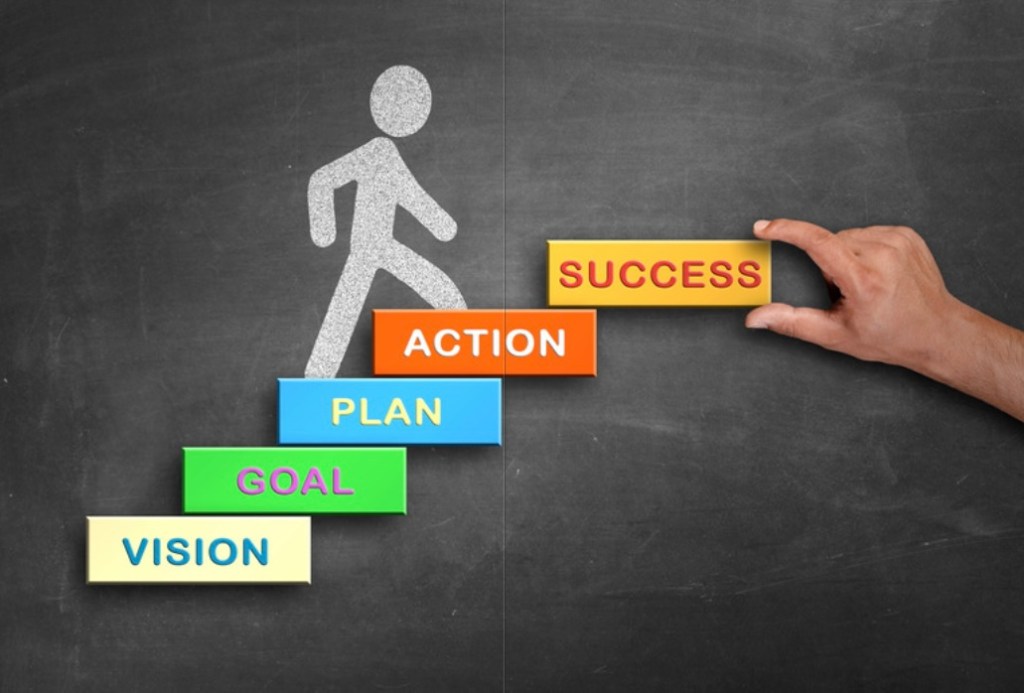
Something else to consider is strategy. Big corporations are excellent strategists. They have a new product they want to roll out, they’ve reflected on the best time to release this product, they’ve considered their best marketing strategy and put that marketing strategy into motion LONG before they launch the new item. This is because excellent strategists understand the idea of VISION, GOALS & OBJECTIVES. The vision comes first. This is our inspiration. We see this amazing, shiny, sparkly idea. We are instantly inspired and this inspiration is what we will USE to motivate us to achieve our future goals and objectives. Our goals are the steps we set to manifest the vision we have. Goals are the BIG steps like the creating of the new item, the marketing campaign, etc. And objectives are the tiny details that are actually the OBTAINABLE steps along the way. The objectives are what make the vision (or resolution) achievable to begin with. If I start with a vision and seek to immediately jump to achieving without understanding this process of vision, goals and objectives, what will happen is I will come across larger than life steps and instantly become overwhelmed and quit by default. This is why it is critical to understand HOW to achieve a resolution BEFORE beginning! Vision: Big idea. Goals: Big steps to achieve the vision (designing the product, marketing campaign, etc). Objectives: Secure the location to create the product, sign up for Canva to create the promotional material, come up with a name for the product). Resolution achievement is found with a step by step process or in some cases a multi-step by step process (there are steps for our goals and then steps for our objectives) and we map out these steps before we begin so that we have a plan to follow!

HOW TO ACHIEVE A RESOLUTION

So, before you even begin to try to achieve your New Year’s resolution, I want you to devise a plan. Ask yourself HOW you will achieve your resolution. Let’s say that your New Year’s resolution is to learn coding and SEO for your online business. While you love running your online business, you HATE all things technical and so finding the motivation to research coding and SEO, watch videos and read blogs on the subject and implement what you learn feels dreadful and so you put it off. As a result, your business stays stagnant and you know that if you truly want to build your business, you will HAVE to motivate yourself somehow to learn this boring stuff. Then you think, “I can set this as my New Year’s resolution!” So now you have a date of when you need to begin learning this stuff. Now what? Think about the parts of researching coding and SEO that you hate the most. Reflect on where your biggest resistances are. Maybe you are afraid to enter new territory? Maybe you are overwhelmed by the learning curve? Maybe you have no idea where to start? Let’s say that in this example, you take all stress off of yourself and enroll in a course instead. This means that your ONLY goal becomes enrolling in a course. Instead of trying to go it alone, you put your trust in someone else who knows more than you do on this subject and you simply show up to the course with notebook and pen in hand ready to learn? Then when the course starts, your notes will act as your guide to set your goals and objectives. The person you are putting your trust in becomes the person who TELLS you what your goals and objectives should be . Can you see how much easier this is? A big reason that people do not follow through and achieve their New Year’s resolutions is because of fear and resistance. 

UNDERSTANDING THAT FEAR IS NORMAL WHEN WE TRY SOMETHING NEW

If we can enter into our New Year’s resolution with the understanding that fear may very well be a part of the process, we will become more likely to achieve our resolution. If we enlist the support of others like with the case of enrolling in a course, we do not have to go it alone and therefore our fears will likely be more manageable. And I get it, sometimes we don’t enroll in the course because we have social anxiety and the overwhelm of our social anxiety is worse than the fears associated with learning new things! There are pre-recorded courses you can take where you can still have the support without having to engage socially! Some people say that fear is False Expectations Appearing Real. When we think about it, what is fear? Fear is the unknown. What we fear most is what we don’t know, what we haven’t experienced yet, what we are unsure about. But desire is fear’s opposite, so if we have a genuine desire for our New Year’s resolution, then we only have two choices: 1. Confront our fears or 2. Stay where we are. 

THE COURAGE TO CONFRONT OUR FEARS

Everything that we want is on the other side of our fears, right? Isn’t that the saying? Jack Canfield was not wrong. Think about everything that you were once afraid of that you are no longer afraid of. How did you arrive at the place you’re at now where you no longer have a fear of that thing? If you were afraid of the water, you overcame your fear by either learning to swim or engaging with the water in some way that you came to see that water was not something to fear as you once believed. Maybe you had a fear of dogs, but then your child loved dogs so much that you had to either disappoint your child forever or face your fears and after you end up loving the dog more than your child! Yes, there are some fears and phobias that desensitization ends up being more traumatizing for, but we are talking about New Year’s resolutions and something that you’ve already declared you WANT! Your desire for that resolution should be high enough that you feel motivated to confront your fears on this subject to achieve your resolution. If your desire is not this high, then the work to be done is gaining insight into why your desire does not match your resolution. 

SET A REALISTIC TIME LINE FOR YOUR RESOLUTION

We often think that when we set a New Year’s resolution we have to complete it by the end of January. I want to remind you that there are 12 months in 2024. And just because you set a New Year’s resolution in 2024 does not mean that it has to be completed before 2025! Ok, if you want to achieve your kayaking goal, shoot for achieving this by December 2024, but if you are trying to learn coding and SEO, remember that coding is a degree program at several universities! And the average degree program is between 2 and 4 years! Some subjects take longer to understand and grasp than others! Just because something takes you more than a month or year to learn does not mean that it is unobtainable! This is why the goals and objectives are so important! If taking an SEO course is one goal, realize that there will be many goals that follow the course which may include taking ten or twenty more courses before you gain even basic understanding on the subject! This is why I suggested making the course the New Year’s resolution rather than learning SEO. Can you see how the former is achievable whereas the latter has massive room for failure? 

SEEK OUT SUPPORT

Some New Year’s resolutions can be achieved on our own. When I set a goal for myself to organize my house, for example, I really do not want anyone else under foot while I am doing this. Something about going through each room on my own is therapeutic. But when it comes to learning SEO, I need all the support I can get! Understanding ourselves and our needs will be the defining factor as to whether or not we achieve our New Year’s resolution. So where needed, seek out support! Don’t be afraid to ask for help! We can still achieve our New Year’s resolutions WITH help! 

WHATEVER YOU CHOOSE, CONSISTENCY AND COMMITMENT ARE KEY

Slow and steady wins the race, right? Algorithms demand our consistency. Without our consistency, they believe we have quit. They have no understanding that we have lives, that it’s the holiday season and we may not be able to post every day or even three times a week. AI does not care about our personal lives, they only care about our consistency! Looking at your New Year’s resolution like AI may prove helpful. To achieve your goal, you will have to be consistent. You’ll have to make a commitment to a particular schedule so that your AI will believe your seriousness! I get it’s a lot of pressure. It’s also like having a life coach with you at all times checking in and giving you immediate feedback. This is why from the beginning I said that if you want to achieve your New Year’s resolution to make it personal! There’s good pressure and bad pressure. I mostly ignore the AI algorithm because I understand my life and my needs and am not one of these blogging empires trying to take over the internet in under a year. My goals for my blog are very different and so I can blog at my own pace and accept the ebbing and flowing of stats, but I appreciate the feedback which at least tells me if I am reaching the right people and creating helpful content. Results happen as we are consistent and committed. While the results might be tiny and we may feel like we are getting nowhere, one new insight learned, one more meal prepared, one more recipe added will eventually add up to big growth! 

CHOOSE SOMETHING MEANINGFUL

So, choose something that is meaningful to you; something that you will have the motivation and desire to be consistent at and committed to and then move at your own pace. I do not care what so in so is doing with their resolutions on the internet. You just keep putting one foot in front of the other at your own pace and I promise you that you will get where you want to go. If you truly want to achieve your New Year’s resolution, you will in your own time! If you end up jumping ship halfway through because you weren’t motivated enough, note that as well! You did not fail, instead you came to realize that what you thought you were mega motivated in, you just weren’t. That’s progress too! Then use that feedback to help you find what you ARE motivated by! 

Much love!

THE 12 DAYS OF SELF-CARE

In this fast-paced, busy life, it is often difficult to remember that we are a person with needs too! With so many responsibilities and daily tasks, who has time to meditate, to read a good book, to play as we did when we were kids? With this being true, I still want you to think about your heart, body, and mind and ask yourself what you are doing today to ascertain that 30, 40, 50 years from now they are still in good function enabling you to continue living the same life you are leading now. It is SO easy to shrug off self-care and claim we will get to it tomorrow, but for the next 12 days, I want you to consider taking on this challenge and see how it changes your perspective and life.

DAY ONE: SELF-KINDNESS

Are you kind to yourself? We tend to work so hard to be kind to others while forgetting to be kind to ourselves! How often do you catch yourself judging yourself, being unkind to yourself, denying your own needs, etc.? Today I want you to try to express self-kindness to yourself at least once! This gesture might be by being gentle to yourself when you make a mistake, by giving yourself permission to take a break, by encouraging yourself to keep going…

The goal is simply to find a way to be KIND to YOU!

DAY TWO: SELF-PRAISE

How many times do you praise others every day? “Great job!” “Well done!” “Way to go!” How many times do you offer yourself the same praise? “I’m proud of you!” “Wow! That was really hard and you did it! Amazing!” “You’re doing a really great job!” Today, I challenge you to praise yourself at least once. In addition, I want you to reflect on how it feels when you acknowledge your own progress, efforts, and excellence! When we realize how little we do these things for ourselves, it’s eye opening and the simple act of one self-praise goes a long way in helping us realize how little we praise ourselves!

DAY THREE: SELF-CARE

When was the last time you gave yourself permission to take a bath? To take a walk? To read a book? To watch your favorite show? Today I want you to do ONE self-care act purposefully! You are scheduling this self-care act and following through on it! NO EXCUSES! When we make conscious and purposeful efforts to take care of ourselves, we begin to FEEL our own worth! As a result, we show up more refreshed, we have more patience and tolerance, we are more energized, and overall more enthused about life! So take care of YOU today!

DAY FOUR: SELF-LOVE

How have you expressed love toward yourself lately? When we love others, we think about their needs and freely give of ourselves to help meet those needs. What need do you have that needs meeting? Today I want you to meet ONE need that you have. After you meet that need, I want you to reflect on how you feel with that need met. Do you feel happier? Healthier? More equipped? More optimistic? As we meet our needs, we begin to feel more empowered and that empowerment ripples to all areas of our lives!

DAY FIVE: REWARD YOURSELF

When was the last time you rewarded yourself for a job well done? Just living life day to day and surviving is a job well done! Life can be challenging and overwhelming and when we expect so much of ourselves and put so much pressure on ourselves, we never seem to see what we have done and ARE doing! Today I want you to take note of all the “little” things that you do every day for yourself and others and reward yourself for a job well done! Go see a movie, take a break, take a day off, engage in a beloved activity, have lunch with a friend…just do something that you perceive as rewarding and joyful! I promise that afterward you will FEEL the benefits of rewarding yourself!

DAY SIX: SELF-REFLECT

Today I want you to self-reflect and meditate on your life. What things are you happy with? What things do you wish were different? How would you like to improve your life? What do you believe that you can improve? What do you doubt you can? When you come across a doubt, I want you to ask yourself these vital questions: 1. why do I believe that I cannot change this thing? 2. Who are the people in my life that I believe are connected to my doubts about my ability to change this thing? 3. If I had more help or support, would I be able to change this belief to a CAN? When we take time to meditate and reflect, we connect with ourselves and with that connection, we become conscious of the thoughts, feelings and behaviors that are keeping us from living our best life!

DAY SEVEN: DRINK & BE MERRY

Did you know that more than half of all people do not drink enough water daily? Adequate water consumption is connected to energy, good digestion, weight loss, and so much more! Oftentimes when we are tired, we reach for things like sugar and caffeine not realizing that we may simply be dehydrated! Hunger pains can also be related to dehydration! We tend to focus so much on the big changes without realizing that the simple act of setting a goal to drink more water can drastically improve our life experience! Today I invite you to drink more water! Just one extra water bottle a day can increase your energy exponentially!

DAY EIGHT: FIND GRATITUDE

Today I want you to list 5 things that you are truly grateful for! These things cannot be things that you THINK you are grateful for, but do not FEEL you are grateful for. The five things MUST be FELT. You’ll be surprised how helpful this exercise is and your eyes will be opened once you realize the things you are actually grateful for! Once you identify the five things you are truly grateful for, consider how you can experience more of these things in your life. Gratitude is the number one feeling associated with living an abundant life!

DAY NINE: LEARN SOMETHING NEW

Did you know that when we seek knowledge and learning that we are nine times more likely to absorb the knowledge than when we passively learn things? Conscious learning has the power to transform our lives rapidly once we believe in this process! If you want to achieve your goals, study all the most successful (and fulfilled) people in the world and what you will find they all share in common is their passion for learning and continuous self-improvement. Today, set your goal to learn something new and see how this inspires you!

DAY TEN: EXPRESS YOURSELF

Today I want you to sing, write, or create in some way! When we express ourselves, we give ourselves a voice and that voice is connected to releasing big emotions within. When we sing, we often connect with the lyricist or singer’s emotions which helps us to connect to similar emotions within and when we feel the message, we are a lot more likely to pull up our own emotions and once those emotions are up, we can release them. Only after we create or express ourselves do we even realize the feelings or thoughts we are experiencing. The simple act of self-expression often leads to us realizing our own thoughts and feelings. And once we realize our thoughts and feelings, we have the power to do something about them if we choose! What will you sing, write or create today?

DAY ELEVEN: PLAY

What do you enjoy doing? Today I want you to do something that you just enjoy. There’s no focus on how this thing will contribute to you moving your life forward. This thing is strictly about feeling JOY. Laugh and be present as you engage in this pursuit. Maybe you grab some sidewalk chalk and draw your heart out on your driveway? Maybe you grab your kid’s legos and build the highest tower? Maybe you call up your best friend and invite her over to play a round of UNO? No matter what it is, the goal is simply to experience PLEASURE! We spend FAR too little time engaging in activities for the simple joy of the activity. We claim we do not have time, we are too tired, our childhood’s are over, etc. Today, your job is to find ONE thing to play. There is no thinking in play! Your job is to simply be present in the moment of enjoying whatever activity you choose to engage in. After, feel free to ask yourself questions like “why did I enjoy that so much?” “What about that activity enabled me to be so present?” These questions may just lead you to making lasting change in your life for the better!

DAY TWELVE: GIVE A GIFT

While I get that these twelve days are supposed to be about you–on this last day, I want you to find someone you feel a strong desire to give a gift to. It may be the homeless man you pass on your way home from work every day or your nephew who is passionate about Pokemon and has been looking for this one specific card to complete his collection. It may also be your daughter who has been wanting your undivided attention for weeks, but life has simply been too crazy to make this commitment. As you reflect on this gift, what I want you to focus on is what gift you can give that will make YOU feel the most. If giving your nephew the Pokemon card is not going to lead to you feeling anything, then that’s the wrong gift. This gift must evoke a strong feeling in you. It must be something that you WANT to give! When you give this desired gift, I want you to focus on the feelings that arise in you as you seek out the gift, prepare the gift and give the gift. Afterward, I want you to ask yourself what about the experience was so inspiring?

Now that the twelve days are complete, how do you feel? Did you enjoy doing this exercise? Was there any one day that you felt was the most life-changing? What inspired you most? Are there things that you will be integrated into your daily life moving forward? If you try this, please share in the comments how your experience with this was and your favorite take aways!

Much Love!

What is the Difference Between Emotional Management & Emotional Processing?

If you’ve ever heard the phrase, “This too shall pass,” then you may be able to grasp emotional processing. When we process our emotions, we let them flow through us without resistance so that we can release them. When we manage our emotions, we see them as something unruly in need of being tamed or as something too big to truly experience in the moment. From a simple definition perspective, this is the difference between emotional management and emotional processing. Emotional management is taming the big emotions so that they do not become out of hand and lead to projection, defensiveness, offensiveness, self-harm or self-destruction. Emotional processing is accepting and allowing our emotional experiences and emotions to flow through us and releasing the cause leading to the emotional experience. When we process our emotions, we find the cause and uproot it never to be triggered by it again. Emotional management is what we reach for when we are unable to process our emotions.

UNDERSTANDING EMOTIONAL MANAGEMENT

Emotional management has many names. Coping, stress management, behavior management, riding out the storm, surviving… When we manage our emotions, we seek to get through whatever challenge we might be having. In the moment, we do not have a belief that we can process our emotions and free ourselves of the cause behind the emotion, so we simply seek to manage the situation. It’s kind of like when we have young toddlers running around our house. That is not the time to tidy our home and stage it for a viewing. Instead, we simply manage the situation. We keep the toddlers alive, we keep potential dangers out of reach, we give them toys and things to occupy them and accept the mess in exchange for happy toddlers. When we are on active toddler duty, we are likely not focusing all our attention on work, on household tasks, etc. And so it is with emotional management. If I get really bad news from work, but I’m about to pick up my two kids from school, melting down or losing it has to wait. And so, I manage my emotions by distracting myself, grabbing a coffee, or just thinking about something else. I suppress the emotions in that moment. Emotional management is what we use when we do not believe that we can experience our emotions fully in that moment and let them flow and release the cause behind the emotion or emotional experience. When we temporarily suppress our emotions, then feel and release them when the time is right, this is healthy emotional management. When we suppress our emotions and refuse to feel or release the causes and instead let the unfelt emotions and emotional experiences build, this is unhealthy emotional management.

UNDERSTANDING EMOTIONAL SUPPRESSION

Sometimes we suppress our emotions only temporarily while we get to safe place to feel them and other times we suppress them for years and years! The problem with doing this is that over time emotional suppression causes emotional sickness. Every emotional suppression causes another layer over a previous emotional suppression. What we must understand about emotional layering is that the only emotion we can process is the one on top. This means if we put off feeling and releasing an emotion and choose to suppress it and then a new emotional experience comes along that we too choose to suppress, before we can process the first emotional experience, we have to process the new one. Emotional layers build and to access lower layers, we have to peel away top layers. If we have a chronic habit of suppression, you can see right away that the clean up job of this is going to be massive when we finally decide to feel and process our emotions! Liken it to a leaf clean up on an acre property surrounded by trees. If we wait four autumns to do that leaf clean up, it’s going to be significantly more involved than if we just did an annual leaf clean up. Our emotions are no different! Suppressing our emotions is not avoiding them. We may be able to deny them and temporarily forget about them, but every time we are triggered and experience a trigger response, that triggering is because of an emotional experience or emotion that we chose to suppress!

Unconscious emotional suppression is the worst kind of emotional suppression because we do not even know we are doing it. As children, we learn emotional management and processing skills and unconsciously we adopt these skills and for many of us never realize that we are engaged in these behaviors so never wake up to become aware that they are learned behaviors. So for most of us, when we begin the process of self-discovery, awakening and emotional processing, we are faced with a really, REALLY big clean up job. When we look at it this way, we can understand why we reach for emotional management or coping mechanisms instead!

COPING MECHANISM EXTREMES

Depending on the level of emotion, different emotional management tactics come into play. For the average person who may have had some life disappointment and hurt may manage their emotions by reaching for sugar when they are stressed or getting busy when faced with big emotions, but for the person who has a lot of trauma, the pain that is experienced may be more severe and so after exhausting all the average emotional management tactics sadly seen as normal–caffeine, sugar, salt, avoidance, denial, etc.–we may see some turning to addictions like drugs, alcohol, sex, gambling, excessive spending, etc. If we can understand that ALL emotional management is an attempt to distance oneself from emotions, we can understand that nobody wants the addiction. What people want is RELIEF from feeling! It is the seeking of relief that sometimes leads to addiction. But addiction itself is sought by no-one. Until we understand this as a society, we will not change how we look at addiction and therefore change how we treat it. If people knew how to process their emotions and that there was a light at the end of the tunnel FROM doing it, there would be a LOT less addiction in our world. Addiction continues to exist because people do not know and therefore when faced between pain and relief, they reach for relief. Furthermore, because we live in a society where suppression, denial, self-deception, avoidance and resistance is the norm with work and 95% of the population is in survival mode, we simply view emotional management as how we regulate our emotions. On top of that, the level of survival mode that we are in as a whole sadly leaves very little opportunity to choose emotional processing over emotional management.

THE TRUTH ABOUT EMOTIONAL REGULATION

When we regulate our emotions, we step out of fight, flight, freeze mode. We pull ourselves back to neutral before triggering. Emotional regulation is not emotional processing. When we process our emotions, we gain understanding about what the cause of our emotions and can then with understanding believe in our ability to allow the emotion to flow until it passes through us. The reason that it feels like there is no end to emotional processing when we give this a try is because we have layers upon layers of unprocessed emotions within us and so, similar to emptying a 24 foot swimming pool, it will feel like the process is never going to end! This is why emotional management and emotional regulation are even a thing. If we were all taught about emotional processing from birth and our society was built in a manner where everyone just felt their emotions in the moment and let them flow, there would be no addiction, no coping, no managing stress, no stress at all! The truth is that we are faced with regulating our emotions and managing them because we live in a society that demands our emotional suppression and shut down in order to accommodate its needs and wishes. What we are most coping with is the expectation to engage in things like emotional management and emotional regulation–which of course expect us to suppress and shut down our emotional experiences to make another feel safe and comfortable. The expectation of emotional management is ALWAYS about accommodating another!

UNCONSCIOUS IMPRISONMENT

We are living in an age where we believe that slavery has ended. We believe that concentration camps will never be a thing again in “democratic” countries. We believe that democratic countries actually have freedoms. This could not be further from the truth! True freedom–EMOTIONAL FREEDOM–is when we have complete autonomy over our time, energy, and choices. That means that when we are truly free, we awaken each day to abundant access to nutritious food, clean water, a safe shelter, ideal temperature control, every other basic need as well as opportunity. We also awaken to complete choice over how we spend our time and energy. This means that we are not bound by a schedule, having to rush around to get kids to school and ourselves to work. We can pursue passions and interests, explore, and basically follow after our own curiosity and feelings. Rare is it to have a human being having this lifestyle and experience. This is because an individual would have to be raised with this mindset and conditioned to the skills, tools, and knowledge to align one’s life in this way. For the majority, we were sent to school and conditioned to become workers for the 1%. Rockefeller himself once said that he was creating school so the 1% could have workers. And so, step one of this massive undertaking of emotional processing is to awaken to the reality of the world we are living in. Until we can see our reality clearly, we can not possibly see our options.

THE OPTIONS

Option one is to stay asleep and radically accept your own reality whatever that is including the ebbing and flowing of emotional regulation and emotional management. Option two is to awaken to reality, accept the self-discovery journey and choose emotional processing over emotional regulation and emotional management. We cannot choose to awaken without also choosing the self-discovery journey though. Once our eyes are opened, they can never be closed again!

PART OF THE JOURNEY

Something that I learned on my own road of self-discovery has been that love capacity and emotional management and emotional processing abilities go hand in hand. If we do not know what true love or real love or unconditional love or authentic love or whatever term we want to use to capture this kind of freely given love without conditions, then we will not grasp the benefit of choosing a self-discovery or emotional processing journey. The difference between emotional management and emotional processing is also to do with perception. If I believe that there is no benefit to processing my emotions–that love will be at the end of the tunnel, for example–I will not feel enough motivation to engage in this feat.

TWO KINDS OF LOVE

When we feel loved and love without conditions we understand the concept of needs. We come to realize that no human can survive without their needs being met. Furthermore, we understand that when another human being engages in unloving behaviors, addictions or unhealthy emotional management, they do so because they are attempting to meet their needs, not to deliberately harm me. And, the behaviors they are engaging in are the only things that they have belief in. When we have perception of unconditional love or real love or authentic love, we have agency. We have free will or personal choice. We can choose between engaging in unloving behaviors, addictions or unhealthy emotional management or we can choose love. Until we have the perception of two polars of love, we lack autonomy, free will or personal choice. We only have true agency when we have perception of unconditional love. This means that it is an impossibility to change behaviors without first becoming aware of and educated on what unconditional love actually IS.

WHAT IS LOVE?

For the person in need of receiving love, love is to be seen, heard, and understood by another. Our needs are seen, our behaviors are understood and our voice is heard. We are known by the loving person and therefore no longer alone in our experience. From our current level of consciousness, we are unable to love ourselves and therefore need to be loved by another. This love may come from authors, content creators, doctors, therapists, friends, or other individuals with the ability to meet our needs. As we humble ourselves to the receiving of this love, we acquire skills and tools which enable us to eventually meet our own needs. Once we can receive unconditional love from others, we can begin to connect with ourselves and discover ourselves and our inner-being (what some call an inner-child) and over time discover the needs of this inner-being and meet his/her/their needs ourselves. This is what self-love is known as–the nurturing and loving of our inner-child. Once most of our needs are met, we can then freely give unconditional love to others because we have the capacity to do so. Prior to this experience, we are bound by conditional love or ebbing and flowing love because when triggered, when unable to process our emotions, when overwhelmed, we will step into unhealthy emotional management patterns and the receiver of our “love” will not feel it as love. It is because our emotional regulation, management and processing is linked to our capacity to receive and give love that makes it the greatest call to action.

PRESENCE AND AUTHENTIC LOVE

Authentic love (or what some refer to as unconditional love, but what I refer to as a more realistic form of human love) is nothing more than accepting another’s free will. When we love authentically, we understand that the only thing we have power and control over is our own feelings, thoughts and actions. And truly the only love that we have control and power over is the love we let in and the love we freely give away regardless of whether others let it in or not. We cannot force love into another human being. Even if we love them with all our might, only they can choose to let it in, but first, they have to believe in it and perceive it as love. We are human. We live in an imperfect world. The vast majority of us are plagued by this triggering/survival emotional experience that requires us to regulate our emotions and manage our emotions over processing them. The BEST love that we can give from this place is well-intentioned love where our intention is to love authentically or unconditionally, but we may become triggered and react as we learn—the commitment to learn and change being the bridge from intention to realizing unconditional love capacity. And so, lifting the pressure from ourselves that we do have our priorities in the right place, we are seeking to love unconditionally and we are accountable when we fall short.

ONLY ONE WAY TO ELIMINATE PAIN

While addictions and coping mechanisms feel good in the moment, they require constant hits to maintain the “feeling good” effect. There’s only ONE way to eliminate pain for good and that is as Robert Frost once said, “through.” Only one way out and that is through. It’s in. We have to accept turning inward. We can’t put off one more day where we let our emotions pile up. For some of us, the emotions reach the top and there’s no more piling that can happen. And once the piling reaches the top, the pain of pressure from so many layers ends up forcing us to respond. I think this is why many sages say that those with the most trauma and pain have an advantage? I have never seen it this way. I only see all emotional management and pain as a call to action to change and rebuild our societal structure to create an emotionally free society where everyone can thrive. As we are learning, we will be at the whim of emotional regulation and emotional management. There’s no way around it. Setting our goal to eliminate our own pain of the past and to learn how to process our emotions gives our lives direction and the hope that as we learn and develop these skills, we can experience a different reality.

WHEN FACED WITH THE CHOICE

When faced with the choice between reaching for long term emotional management or emotional processing, consider this: There is an absolute time to reach for emotional management. One of this times is when we are first learning emotional things and we have yet to reach a place in our development to understand how to process our emotions or before we even gain intellectual understanding of emotional management and emotional processing. During this time, the best course of action will be to manage our emotions. But as we grow and the longer we are on the journey, we come to find ourselves faced with the conscious choice to choose between emotional management and emotional processing. When we reach this place in our development, here is something that can help you to decide. When faced with the choice, look at emotional management and emotional processing like this: Authenticity desires you to win. Propaganda wants to win. Authenticity desires you to process your emotions and gain true emotional freedom. Propaganda desire you to manage your emotions so you stay dependent on the system. When we choose emotional management long term, we choose the same system failing billions of people every day. When we choose emotional processing, we take steps toward creating a new earth–a new world filled with conscious people with their own agency–where we are all emotionally free!

This is my hope for you, Discoverlies!

MUCH LOVE!!

UNDERSTANDING THE DIFFERENCE BETWEEN INTELLECTUAL UNDERSTANDING AND EMOTIONAL UNDERSTANDING

Have you ever known about something? Like REALLY known about it? So much so that you don’t even think about whatever it is you know about? Maybe you’re a wiz at wrapping presents or playing a certain video game. Your skills are so ingrained that you feel like you use little energy or brain power to complete the task. These are examples of emotional understanding. Your skill set has reached a level where you have so much confidence, self-assurance and self-trust in your skills that you do not pause for thought on how to do the task. While intellectual understanding may seem similar the difference is that when it comes time to apply the skill to daily living, we tend to become more clumsy and less self-assured. We may start out confident, but as time goes by and we attempt to apply the skills we’ve learned, we realize that we do not know as much as we thought we knew.

Here’s a test you can take to determine whether you have an intellectual understanding on a topic or an emotional understanding. Take the test as many times as you want on different topics to get to know yourself better: (some topics to consider: relationship management, self-awareness, money management)

INTELLECTUAL UNDERSTANDING TEST

  1. Are you good at rote memorizing the topic of interest? If you read or watch enough content on this subject, do you find yourself able to recall the knowledge and engage in confident conversation on the topic? Are you able to easily pull facts that you remember on the subject?
  2. Are you able to teach the subject from an intellectual perspective meaning you can share the facts you learned with another so that they can intellectually understand it?
  3. Are you able to use the knowledge and facts to create your own content on the subject with little reference back to the material?

EMOTIONAL UNDERSTANDING TEST

  1. Are you easily able to apply the knowledge toward your own relationships, money management, wellness, etc. and get the results you seek on a long term basis?
  2. Are you able to see positive results in your life after applying the knowledge, techniques, etc. to your own life? Are you able to be consistent with this application?
  3. Are you able to trouble shoot solutions pertaining to this topic using the information you’ve acquired or do you end up getting confused or unable to conclude a solution? (In other words, would you have to watch a ton more videos to find the answer to the solution?). Emotional understanding would simply KNOW the answer with little effort.

When we emotionally understanding a topic, we can apply the knowledge to our daily living consistently. In essence, we transfer what we’ve learned to our lifestyle and live the principles daily. Since we understand the material so well, we simply KNOW what to do as problems arise. When we only intellectually understand a topic, we can recall and share about the topic, but when it comes time to apply it to daily living consistently, we have to refer back to the material, spend many hours reflecting before we know what to do, and have a lot more failed outcomes.

HOW DO YOU GAIN EMOTIONAL UNDERSTANDING?

Once we’ve acquired all that we can on a particular topic to the point that we can confidently share facts, teach on the subject and create content, we have enough understanding to begin to transfer this knowledge to our daily living. As we practice applying the information to our daily living we will begin to gain new knowledge and understanding from life’s feedback. When we apply techniques learned and they do not yield the results we seek, we can note the mistakes and failures so that we can reflect on what we think went wrong and what a better solution would be for next time. As we attempt this trial and error approach, engaging our higher order thinking skills, we will develop greater understanding and with this understanding we will build confidence with the material. Over time, we will deepen our understanding on the particular topic until we can transition from intellectual understanding to emotional understanding. Emotional understanding is only possible AFTER we’ve engaged this process for an extensive period of time. Think of intellectual understanding as your medical school training and residency and emotional understanding as your medical career. Until you apply what you’ve learned in medical school, you cannot really say whether or not you grasp the material. It’s not until we apply what we’ve intellectually learned that we determine how much we actually know.

THE HARD TOPICS

For many, it’s easy to go to medical school and do a residency. It’s easy to begin our career as a doctor, but not as easy to deal with the challenges that arise like not having answers for a patient or not being able to save a patient. It is these challenges that lead to us seeking greater knowledge and understanding to begin with. Usually, it is only after we reach a wall that we seek after true understanding. In fact, it is not until we reach a wall that we realize that we don’t possess true understanding or emotional understanding. It is from the hard topics that we begin to get a true picture of our current understanding.

3 EMOTIONAL UNDERSTANDING SKILLS TO SEE IF YOU HAVE:

  1. Emotional Identification: Are you able to feel and sense your emotions on the topic? Can you identify any fears or doubts related to the topic?
  2. Emotional management: Are you able to access healthy emotional regulation, coping and stress management skills when you get triggered on the topic? Or do you just fly off the handle or shut down?
  3. Emotional processing: Are you able to stay present in whatever emotion is triggered and allow the emotion to flow through you so that you can release it or do you resist this process and seek coping mechanisms to shut down the experience?

When we emotionally understand we are able to engage these three steps above with ease. We experience emotional freedom 24/7 and utilize this formula in our personal and professional lives without even really thinking about it which results in a joyful and peaceful experience.

RETURN ON INVESTMENT

There is no greater return on investment than emotional learning. Einstein once said that we can only understand something when we rise to the next level of consciousness. If we are unable to answer yes to all three of the emotional understanding questions in the topics of interest to us, then we lack the skills and tools we need to achieve our goals. When we make emotional understanding our priority we will begin to see the same level of return on investment as we do with retirement.

AN EMOTIONAL UNDERSTANDING EXAMPLE

I’ve been a teacher for over 30 years. I’ve taught thousands and thousands of children. I’ve worked with neurotypical and neurodivergent, disabled and non-disabled, every socioeconomic population and everything in between. What this experience has gifted me is the ability to perceive needs on an intuitive level. When I first started teaching, I had a natural ability with kids. Kids tended to like me and gravitate toward me. It wasn’t anything that I was doing or not doing, it was more just a gift or talent that I had. But early on in my career, I lacked emotional understanding on many topics such as life circumstance, special interests, and emotional maturity which affected my ability to fully reach kids in the way that I would years later.

When I was in my early twenties, I had a very old school approach to teaching. I was the one in charge and my students were expected to listen to me and do as I asked. Anytime that I had an “unruly” or “disobedient” child, I would approach my classroom management strategy with the use of consequences. I’d use time out, loss of privilege, etc. and to the untrained eye, I was perceived as an “excellent” teacher who demonstrated “exceptional” classroom management skills. I look back in horror at those early years and would classify myself as someone who was a “terrible” teacher with “poor” classroom management skills. But this is only because I’ve acquired SO much emotional education and understanding that I understand things like consciousness, will and love now and have since shifted my teaching approach to that of authentic love and radical acceptance. I now understand that every child is different with different needs, life circumstances and understanding. As such, every child must be greeted where they are and without judgment. Classroom management is not even something that I reference anymore as classroom management is nothing more than controlling the masses. Now, I create learning spaces where I present a topic to my students and accept that not everyone is going to want to engage in that topic. That means that I need to have other options available for the students who do not want to engage in that topic. Eventually, I will present topics that every student will naturally want to engage in and everyone will “learn” something. But as a teacher, my job is to educate my students and I understand that learning can only happen where organic curiosity and natural motivation are. This is why I create a learning space now where all of my students can be engaged and where there are ample opportunities for them to take breaks, rest, recharge, engage in special interests, drink, eat, play, move, etc. I emotionally understand learning, human behavior and human emotions now and this makes all the difference. While to the lookers on, my classroom continues to be “well managed,” the approach is entirely different to my early years as a teacher. I’ve gained emotional understanding on teaching and learning now. I can apply the knowledge I’ve acquired without thinking about it and yield the results I seek consistently.

AN INVITATION TO GAIN EMOTIONAL UNDERSTANDING

Are you a manager? A leader of some kind? A teacher? A parent? An influencer of youth in some way? (marketing & promotions is a youth influencer!) Are you an influencer of others in any way? If so, then consider gaining emotional understanding on the topics that are important to you. I can think of no single skill set that can catapult your career more than emotional understanding. When we can lead people with love and kindness instead of force and control, we have the capacity to use inspiration over demand and special interests as a motivator. People tend to respond much better when given choice and the use of autonomy. When we have emotional understanding of leadership, for example, we can see the needs of others, we can feel their emotional states, we can sense their desires and aspirations and we have the capacity to love without conditions. When our employee is not happy, we no longer feel upset when they give us their notice and move on to greener pastures. Instead we root for them and want them to be happy and fulfilled. Furthermore, we no longer pay our staff minimum wage to secure our own financial freedom. Instead, we see the value in our employees and feel genuine gratitude for all they do for us and our business that keeps it thriving and these genuine feelings of gratitude influence our generosity. An emotionally intelligent person is one who is aware of themselves, their emotions and their actions. With the self-insight, they have the ability to intuit others and have the emotional capacity to feel things like empathy, compassion, genuine concern for others well-being, etc. When we increase our emotional understanding of things we enrich our skill set.

WHICH CHAPTER ARE YOU ON?

Strength of character is what all of the fairytales and heroine journey stories strive to teach us. All the great sages, authors and artists of our past and present understand this which is why they are so inspired to create about it. When we become conscious of ourselves and others we come to emotionally understand the why of the heroine journey story. Each of us is a character in our own stories. The people around us are the supporting actors and actresses in our story. Where we are emotionally on our journey determines which chapter from our story we are on. The best way to reach the end of our stories is to acquire understanding in some capacity that changes who we were at the beginning of our story and gives us the skills and tools we need to achieve whatever goal it is we set for ourselves at the beginning of our story. No character ever achieves his goal absent emotional change. All characters have a plot and subplot. The subplot is where the emotional change happens which enables the character to achieve his goal (which is what fuels the plot). When we can see ourselves as the protagonist in our own story, we can no longer feel insignificant. As the hero of your story, what outer goal or plot are you seeking after and what inner achievement or subplot must you achieve to reach your outer goal?

Much Love!!

Turn your New Year’s Resolution into a Lifetime Resolution

Ugh! New Year’s! Why does everyone make such a big deal about resolutions and why do we all start off so motivated and excited, but by Valentine’s Day, we all seem to be buying those damn big boxes of candy? I’ll tell you a secret! Our emotions are in the driver’s seat of ALL resolutions. Doesn’t matter how strong our will is, in the end, absent emotional understanding of ourselves, our emotions are the trump card.

SO HOW DO WE TAKE CHARGE OF OUR EMOTIONS?

9 out of 10 times, when we are reaching for something that is not good for us, we are doing so because we have been conditioned to seek that behavior pattern to calm our nerves and manage our emotions. Maybe our dad would come home from work grumpy and our mom taught us early on to stay in our rooms and play quietly to give him space and quiet when he came home. Now, in our adult life, anytime anything mirrors this dynamic we find ourselves “playing quietly” in our room when we want to be working on our goals! It is not enough to tell ourselves that we are not eight years old anymore. Our eight year old self cannot hear us. There’s a disconnect and when times of stress arise, all she wants to do is run to her room for comfort and safety–her fear makes her deaf. So, before we can inform her that she no longer needs to hide in her room, we need to gain understanding of her so we know how to communicate with her so she can hear us! The only way to connect with her and communicate with her is through self-connection.

HOW DO WE BECOME IN TUNED WITH OURSELVES?

STEP ONE: BECOME THE WATCHER

The first step is to learn how to see our inner-selves. Until we are able to identify the behaviors, feelings and thoughts associated with our inner-selves, we will not be able to know what to do next. Observe yourself retreating to your room, take note of the feelings arising within you, pay attention to the thoughts running through your mind. If you feel inspired, begin to write down your observations so that later you can process your experiences. Once we gain insight into our own thought and behavior patterns and can connect feelings with past experiences, we can transition into step two.

STEP TWO: BE KIND TO YOURSELF

Our inclination is often to judge ourselves once we identify behaviors and thought patterns. “Uck! What is wrong with me?” Please do not do this. There is NOTHING wrong with you! None of these things are your fault whatsoever! You were a teeny tiny child when you absorbed these thought and behavior patterns! It’s an eye-opening experience to come face to face with the unconscious. Believe me, I get it! But it’s also a miraculous experience because beyond the UCK is your dreams, goals, and perfect vision for your life! And that is why it is so very important that we are kind to ourselves! Absent kindness and gentleness, we create another obstacle to overcome! As an observer, there is no judgment. All we are doing is taking note of what IS.

STEP THREE: BEGIN TO PROCESS AND MAKE CONNECTIONS

If your childhood experience involved your mom taking out a pint of ice cream anytime she was stressed and now you are watching yourself doing the same, take note of the behavior pattern. You now know why you are doing what you are doing! You LEARNED this coping mechanism! FEEL that! Embrace the a-ha moment! You now know why you are constantly at the table with a pint of ice cream every time you are stressed! The pint of ice cream is simply a coping mechanism you LEARNED! And this coping mechanism is so engrained that now, when you are stressed, the only way you know how to manage the anxiety is to eat the ice cream! It’s the only tool you have in your stress management tool box! If your New Year’s resolution is to lose weight, can you see how understanding this dichotomy is so very essential to achieving your goal? We can increase the tools in our stress management tool box and with the added tools comes added choices and options!

STEP FOUR: DON’T EAT THE ICE CREAM

If you can allow yourself to be overwhelmed only a little, there is much wisdom to be gained. When we make a conscious choice to resist our urges to unconsciously self-soothe and we choose to instead see what our feelings are all about, we take a step closer to being able to clear the block standing in the way of our emotions freely flowing. If you’ve read past blogs of mine, you remember that emotions are just energy flowing. It is our emotional blocks that keep them from flowing. Absent blocks emotions just flow. We were taught to shut down the emotion with the ice cream, with quiet, etc. We were taught to shut down our needs so that our dad could have quiet when he came home, for example. As a result, we learned that emotions should be shut down rather than felt. As a result, a lot of our emotions became stuck and the shutting down behavior became the block keeping the emotions from flowing. That means that the only way to get our emotions to flow is to remove the behavior associated with the emotional shut down. And once we do that, the emotions should automatically flow.

STEP FIVE: BECOME THE WATCHER OF THE EMOTIONS ABSENT THE COPING MECHANISM

What feelings are arising when you do not engage in the coping mechanism? What sensations are you feeling? Is your heart pounding? Are you shaking? Have you lost all ability to think? Or maybe your thoughts are racing a million miles a minute? Is all you can think about getting back into that safe place? Are you able to breathe? If so, try to take a deep breath from your nose and inhale to your belly. Try to hold onto the breath for a minute before exhaling. When you exhale, exhale hard to release all the air. Try doing this for as long as you can to stay present. After the breathing, see how you feel. Do you feel any calmer? Any safer? Any better? Or are you just as anxious and desirous to reach for that coping mechanism? If you are finding it challenging to do this work, reach out to a mental health professional who can support you so you don’t have to go it alone!

STEP SIX: PROCESS OUT THIS EXPERIENCE

What did this experience teach you about yourself? At the very least, are you now able to see the connection between your past and your coping mechanism? If the answer is yes, then you’ve opened a window into your consciousness! Congratulations! Now you understand how the process of self-discovery works! The more that we allow ourselves to experience our emotions instead of shutting them down, the closer we get to self-connection. Once we process out enough of these experiences, we become so confident with the process that we really do not need to read blogs like this one. We will just understand and best of all, DESIRE to do the work. We will see the benefit. We will see our lighthouse (our New Year’s resolution) at the end of the tunnel waiting for us and we will feel our stuck emotions and want to move the blocks so they can flow knowing once they do, we win. Emotional processing is not really as complicated as people make it out to be. The MOST complicated part of emotional processing is our resistance. FEAR stands in the way of so much growth. What we do not know or understand (or believe in) causes us to resist. We believe in our pint of ice cream because it’s familiar and it eases the anxiety in the moment–it works immediately. But afterward, that extra 50 pounds we are carrying around remains the same. We appreciate the self-soothing in the moment, but then fight with our negative thought patterns after when we gaze at ourselves in the mirror, when we struggle climbing the stairs without getting out of breath. This is because we believe MORE in the pint of ice cream than we do in the natural process of self-connection, feeling our emotions and letting them flow. Our environment taught us that the right thing to do was shut down our emotions, so now letting our emotions flow feels awkward because we are so used to shutting down our emotions. Before we can believe in something new, we must SEE these truths and FEEL them for ourselves. Only after we see and feel will we be able to decide for ourselves the cost/benefit of both options.

STEP SEVEN: TAKE YOUR OWN SELF-DISCOVERY JOURNEY

Now that you’ve done a test run, consider taking your own self-discovery journey. Instead of setting a New Year’s resolution that you likely are not going to keep, why not set a Lifetime Resolution to become conscious? As a conscious person, you’ll have complete dominion over your emotions, thought patterns and behaviors and setting and achieving goals and objectives will become a lot easier. You’ll never have to set another New Year’s resolution again because instead you’ll be working toward your best life every day!

FIND YOURSELF, FIND YOUR ANSWERS

Once we discover ourselves, we discover our younger selves and we become able to connect with her/him/they. Connection enables us to nurture and meet our younger self’s needs for ourselves rather than waiting on someone else to do it for us. It enables us to understand our past and present selves. It enables us to have clarity on our thoughts, behaviors and emotions and as such enables us to simultaneously have clarity on best solutions. We are all different so googling “how to self-care” or “how to achieve my goals,” is likely not going to bring us the answers that will best help us. ONLY turning inward and finding ourselves can yield us the BEST answers. EVERYTHING you want to and need to know can be find within you. There is nothing that I can say or do that will be more helpful than what your inner-self can say to you! I am only here to assist you with the work TO unite you with your inner-self. Once you become connected with your inner-self, you will not need somebody like me! And that is my hope for you, Discoverlies! I created this platform because I knew my early struggles trying to find information, trying to find knowledge and wisdom to assist me to calm the war going on inside of me, to ease my anxiety, to change my dysfunctional behavior patterns…to achieve my own New Year’s resolutions. And in the end, that entire journey brought me full circle to myself.

THREE MOST IMPORTANT QUESTIONS TO ASK YOURSELF

I no longer set New Year’s resolutions. My resolutions are integrated with my life goals now. Here are the three questions that I concluded are THE most important if you choose to kick New Year’s resolutions to the curb and instead make a Lifetime Resolution.

  1. WHO ARE YOU?

Do you know who you are? Like REALLY know? I am talking deep down knowing. Do you know what your true desires are? Do you know what your personal values and beliefs are separate from conditioning? Do you know your integrity? Do you know your worth and value? Can you FEEL this worth and value? How about your life purpose? Have you reached a place in your life where you have a sense of knowing that there’s a reason that you are here and that nobody can do or give what you can? When we know who we are intimately, we develop an inner-confidence and self-assurance that cannot be shaken by even the darkest critic or fiercest hater. Once we truly know ourselves, we desire our authenticity more than we desire acceptance or approval.

2. WHERE ARE YOU GOING?

Do you know your direction? What path are you on? Do you know the reason you are on that path? Do you know where that path leads and the ends to that path? Is your lighthouse at the end of the tunnel about you are is it about someone else? When we know where we are going, we feel confident and clear on that destination and with that confidence, we trust the destination we’ve set for ourselves and believe in our ability to reach it. While we may be miles from where we are heading, we trust fully in the charted path. And the simple act of having the destination carries us for years and years as we ebb ever closer to arriving at our desired destination.

3. HOW ARE YOU GOING TO GET THERE?

When I determined where I was going–self-discovery and authenticity–I already knew how I was going to get there. Having been on the path for over a decade, I learned the formula of emotional identification, emotional management and emotional processing. I came to understand relationship management and processing. I gained insight into the importance of priorities and boundaries and the power in slow and steady consistency. Most of all, I learned the power of faith and trust in the universe and its assistance program that is powered by my and other’s personal requests. I need only ask for help and help comes. All I had to do was learn to ask the right questions and develop patience for when those questions would be answered. Sometimes, I have to gain more knowledge and understanding on something before the thing I am requesting gets granted. For example, if I want to eat nutritiously, I first need to understand how my body works, what it needs and how to decipher between what is nutritious and what is not. Furthermore, I need to learn what is nutritious for my body versus someone else’s. It’s a process. And for me, after being on the journey long enough, I simply discovered that setting my goal of achieving something like paying off a debt was not as inspiring as setting a goal of self-discovery. For me, I learned that the more that I know and understand about myself, the more conscious I will become and with that consciousness the more likely I will know what the next best step is. I discovered along the way that I can influence my outcomes through conscious perception. When I can see the next best step, I do not have to engage guess work. And I found that the only way to have such perception is with self-discovery. Self-truth precedes universal-truth, so the more I know myself, the more I will know everything else.

Lifetime Resolutions give us focus. They give us direction. They also give us a lot more grace and mercy. Learning is infinite and only possible with mistakes. We learn through trial and error. And many times, it is from our errors that we see the answer. In my opinion, New Year’s resolutions are a lot of pressure. They require a lot of will power and tend to come with a lot of misery. I remember diets I’ve been on in the past that involved my will power. I despised the kale and spinach and eventually became rebellious and said, “Fuck it! I am having the brownie!” which of course led to more than one brownie and a vicious cycle of self-loathing. Been there done that and never found any self-confidence or self-worth. I found things like self-love, self-compassion, self-understanding, self-care, self-confidence, self-assurance, meaning, hope, faith, and love on my self-discovery journey. And during this journey, I have found that lasting achievement is possible once we are achieving things for the right reasons.

DO IT FOR THE RIGHT REASON

FAR too many of us are chasing goals to be liked, to be approved of, to be accepted, to belong, to be loved…

“If I win this title, everyone will have to love me.”

“If I make this much money, everyone will approve of me.”

“If I rise to the top, nobody will hate me.”

These are the types of thoughts that often propel people’s New Year’s resolutions and goal setting. They are not about self-care at all. And we wonder why so few can achieve their New Year’s resolutions. Long ago I adopted a self-belief that I would rather be alone and myself than with people. The pain and stress involved in being liked and accepted by others was too great. At one point in my life I accepted that nobody was going to like me. I was unlikable. I of course, later discovered that I was likable to the right people, but before I could discover this, I had to be where I was and so, I accepted that I was unlikable. This simple acceptance freed me because it enabled me to drop all the approval seeking, acceptance seeking, people pleasing behaviors that I was engaging in that were draining all of my time and energy. With those behaviors no longer weighing me down, I could use all that time and energy toward pursuits that actually mattered to me! Along the way, I discovered a liking for myself and with this self-confidence, I quickly found others who liked me too! And what a difference it is to be in relationships with people where I can leave the mask at the door! How much easier it is to just be myself than to pretend! I learned that it was better to be myself and have a handful of people who liked me and accepted me than having to wear around a heavy mask and seek after goals that only drained me and left no lasting joy. Instead I decided to figure out what made me happy and what the ideal life was for me. What this taught me is that Lifetime Resolutions give our lives direction and purpose and with them, there is no need for New Year’s resolutions!

EMBRACE YOURSELF

You ARE lovable, Discoverlies! You ARE worthy! You deserve EVERYTHING that you desire and this New Year’s, I want to learn that you are believing in these truths for yourself and taking action to not let another day go by where you are trapped in old behavior patterns! Embrace who you are right now and believe in who you TRULY are! Believe in your worth to discover who you truly are! Once you believe it, all that’s left to do is take the first step.

I believe in you, Discoverlies!

Much Love!!

Desire, Expectation and What we have Faith in

Nothing is more powerful than belief. If I desire a loving partnership, but expect another codependent one to come along, then what I have faith in is the codependent relationship. ONLY diving into the emotions of my desire, expectation and faith can lead me to acquiring what I desire.

WHAT IS DESIRE?

Desire is the longing or burning feeling we get when we really want something. When we truly desire something, it’s a tangible emotion we can feel. We can have a desire for more money, a relationship, the healing of someone we love, a gift, receiving a job promotion or any other goal, objective or aspiration. Desire is something that can grow over time. Desire absent asking or action is just a feeling. Desire is the spark that leads to a flame.

WHAT IS EXPECTATION?

Expectation is what we believe we are worthy of or deserve. When we expect bad things to happen, this may be because in the past, similar scenarios have presented themselves and something bad was always the end result. When we expect something, we may believe that we are entitled to it or that we have earned it in some way. Sylvia Plath once said, “If you expect nothing, you’re never disappointed.” Expectation is closely linked to emotion. When we expect something, we have a strong belief that we are entitled to it and when we do not get it, that is when the oppositional emotions of anger, jealousy, and disappointment can arise. Understanding this can help with realizing that to get what we desire we must expect that it will come. However, understanding that expecting the universe to bring us something and being open to how that something comes is different than projecting expectation onto one person and believing that if they love us, value us or care about us, that they will give us what we want will lead us to anger, jealousy or disappointment. When we have a pure desire, a confident expectation that this desire will be granted and faith in it coming along with the openness for how it arrives, we will be able to steer clear of oppositional emotions because we will understand the process and have faith in it!

WHAT IS FAITH?

Faith from a religious or sometimes spiritual perspective suggests this idea of believing in an entity outside of ourselves to bring us whatever we desire or need. Faith can also be a tangible feeling. When we have enough wisdom and experience with something, we begin to have faith or trust in some things and not others. I may have faith that I’ll wake up tomorrow, that my job will still be there 20 years from now, that my partner is committed to me for life…after we have enough experience with something happening, we grow to have unconscious faith that it will happen again tomorrow and the day after that. Having faith in a new desire may prove more challenging for the unconscious of faith because there is no history with new desires. It is often the new desire that makes us question our own faith or belief that this new thing will come. Faith as I am talking about is something that is developed through a self-discovery process. Once we become conscious of our beliefs, thoughts, conditioning, emotions, and behaviors and can test them against our faith we can come to discover what we truly have faith in. When we have faith in our desires, we always get them. When we have faith in our doubts, we always get them.

HOW ARE DESIRE, EXPECTATION AND FAITH LINKED?

When I have a desire and I expect to get it, this can be considered faith. I believe that I will get it. “Ask and it will be given to you,” is the old principle we’ve all been exposed to, right? If we’ve had a childhood where we learned that what we desired or wished for would come to pass, we came to believe in this idea of “asking and getting,” but for those who had a childhood where when we asked for something, we either didn’t receive it or hardly received it, we come to have a belief in “ask and you will not receive,” mindset. Our conditioning plays the most pivotal part in this dichotomy of desire, expectation and faith.

If we have a feeling of desire and a belief that we can receive the desire, then we have a higher chance of getting the desire.

If we have a feeling of desire and a belief that we cannot get the desire, then we have an even higher chance of not getting the desire.

UNCONSCIOUS CONDITIONING

Our conditioning plays such a powerful part on our unconscious mind (which is to say the mind that is in charge of this desire, expectation, faith trio). When we become conscious of what we feel, think and do, we simultaneously gain dominion over our unconscious mind. Through investigative and exploratory work, we discover all the parts that make up the whole of our human experience. I call this investigative and exploratory work, SELF-DISCOVERY. It is ONLY through self-discovery that we gain the insight and understanding of how things like desire, expectation and faith are all interconnected and how to influence our own desires and outcomes. Absent this process, we are at the whim of blind faith. With this process, we come to see not only how faith works, but the force behind faith actually working.

THE PRINCIPLES ARE TRUE

I have a practice that I started early on in my self-discovery journey. At first I would try to learn and understand everything, but after awhile, I realized that there was no way that I could have infinite knowledge and wisdom. Every day I gained new wisdom and so it became an impossible goal. I created a filing system in my brain instead of three bins. 1. What I know is true. 2. What I think is true. 3. What I still do not know. ALL of the stories of our past–the Old Testament, the New Testament, pretty much all religions, Native American stories, the question of whether Jesus was a real person or a story, the extraterrestrial theories, the matrix and so much more all fall into the “what I still do not know,” bin. And this is after I pretty much obsessed about the book of Genesis for a few years which led me to do extensive research into extraterrestrial, genetics and virtual realities. In the end, while I came to conclude that genetics is not only a thing, but that it is so accurate and so awe-inspiring that if I could get a redo on college, I would major in genetics, for sure! The point I am trying to make is that years of study and research could not answer the questions that I had about certain subjects. Instead I found that taking my own journey, applying all of these teachings–I amalgamated my own recipe from everything I learned–I could discover for myself what is true and what is not true (even if my truth is different than others truth!). And I want to say here that this is not to say that I do not find value in all of the listed resources above. Like Einstein, I find Jesus to be a fascinating character. It is more about the subject of absolute knowing and for me I have found that taking the journey Jesus and other sages suggested is how I am determining for myself.

Here’s one thing I found to be true: Desire, expectation and faith are interconnected. When we believe in one outcome at the conscious level, we cannot get its opposite. Our desire, expectation and faith must be in alignment to receive whatever desire we have.

CHANGING OUR BELIEFS

It is impossible to change our beliefs at the unconscious level. Auto-pilot is much too powerful and even with the strongest of wills, auto-pilot will win in the end. This is why it is essential to become conscious of our desires, expectations and faith. It is only where we are conscious that we can see for ourselves what is happening and why it is happening and therefore implement solutions to resolve whatever block or false belief is in the way of us manifesting what it is we desire. If I believe that only God can heal my sickness and I am unconscious to the truth that if I change my eating habits and get healthier that I may be able to heal my own sickness, I will not engage the latter. Here’s a story I was once told that I feel is super powerful in helping to understand this theory.

John was in the ocean practically drowning. He had nothing, but a small piece of wood to grab hold of. He called out in prayer for God’s help–for someone to rescue him. About an hour later a boat showed up and offered to pull John to safety. John replied, “No thanks, I’m waiting on God.” And so the boat drove away. About an hour later, a helicopter showed up and threw down a ladder. John once again declined the help claiming he was waiting on God and the helicopter flew away. Finally, an old man in a row boat came by and threw a life saver over board for John to grab hold of. As you might already guess, John declined the offer, only the man in the row boat being very wise and understanding desire, expectation and faith said to John, “Have you not prayed for help?” And John replied, “Yes, I have.” So the old man tossed the life saver again and said, “Then grab hold. God heard your prayer, but is much too busy to rescue you himself so he sent me. Get in.” And so it was that John’s beliefs were challenged. To survive, he was forced to put blind trust in a new belief system in order to live. Simultaneously though, his experience shifted his faith as he could now see with his own eyes how his desires were answered and how his expectations and faith my not be in alignment.

HOW TO CHANGE A BELIEF

Before we can challenge a belief, we need to understand the feedback system for studying our progress on changing a belief. This feedback system is our emotional system. The reason that Sylvia Plath said “if we expect nothing, we are never disappointed,” is because she understood the following:

When we expect things from others and we do not get them, disappoint is among the feelings that arise. If we do not like feeling disappointed with our current experience with the person “disappointing us”, then we only have two choices, to stop expecting things of this person or to continue to suffer. When we make the decision to stop expecting things of someone and then run into the same disappointment with every other person, then we step into the realm of self-reliance or God-reliance. Rumi once said, “I searched for God and found only myself. I searched for myself and found only God.” This quote perfectly captures the idea of self-reliance to find God and God-reliance to find self. Once we radically accept that expecting from others is not always guaranteed and that there will be times when we do not get what we want and we could be disappointed or angry, we understand that we have other options. We can depend on ourselves or on an omniscient entity or entities. We can grow and learn how to discern those individuals who do have the capacity to help us or we can grow to see and appreciate that which is given to us freely even if it does not measure up to what we expect it to be. All of these things are ways that we can change our beliefs. We can change how we perceive our reality–instead of expecting, simply be grateful for what we are given–or we can accept personal responsibility to let go of relying on those around us who are unable to meet our needs and seek out alternative ways to meet those needs. Changing beliefs is all about first SEEING our beliefs, second FEELING our beliefs and third, CHOOSING our beliefs. Just because we have been conditioned to believe a belief does not mean that we have to believe it anymore than it means we have to feel it. If something is not working for us, we have the power to change it. At the same time, changing a belief is easier said than done. I will write a blog on this at a later date!

BELIEVE TO RECEIVE

If we have reached a place in our development where we have shifted our mindset from blind faith to conscious faith, then we understand the concept that we have to believe to receive. One powerful way to take the self-discovery journey is to use something that we truly desire to act as our lighthouse. This light at the end of the tunnel acts as our inspiration reminding us why we are on the path. It gives us hope in times of doubt. It motivates us to keep going. When we have faith in a desire and we understand that when we are not immediately receiving a desire, the problem may be with us. We may believe that we believe in something, but upon deeper reflection we come to discover that an unconscious belief deep down still exists. We discover that when it comes to achieving big dreams, that can only happen after we’ve completed every obligation and responsibility and so like Cinderella, we believe that until every chore is complete, we cannot prepare ourselves for the ball. We have a belief that we must take care of everyone else first. As we discover the blocks holding us back, we can do the work to change these beliefs and with the changed beliefs and actions, move the block and progress.

ALIGNING OUR DESIRES, EXPECTATIONS AND FAITH

Similar to aligning our feelings, thoughts and actions, only aligning our desires, expectations and faith with each desire we have will lead to us receiving the desire. If we expect that we will not get the promotion because we are not as talented as our coworkers, then it does not matter what we desire or have faith in, in the end, we will not get the promotion. Instead we will experience the same reality that we have always experienced again and again. Until we understand what the CAUSE of not receiving is, we will not be able TO receive. If we desire a loving relationship and we have done our emotional work to pluck out the beliefs of unworthiness and now expect to and have faith in a loving relationship, we will attract a loving relationship. Simialrly, if we do not attract a loving relationship and believed that we did all the work to pluck out our incompatible beliefs, then we will know that we have not plucked out our incompatible beliefs and be clear on the work to be done.

A NOTE ABOUT OTHER’S WILL, SICKNESS AND MIRACLES

When we desire something that involves another person, we must understand the principle of control. We only have control over our own feelings, thoughts and actions. If we desire a relationship with someone, for example, and that someone does not want a relationship with us, our desire cannot be granted with all our will and emotional work. Instead, we can desire to have a relationship like this one or perhaps if we believe this person is our soul mate, we can continue to desire the relationship while accepting that we are powerless to the other person’s will and desires. Similarly, when a loved one is sick, we can pray for miracles, but we are not in control of those miracles. This truly is an example of something that is outside of our abilities. We can pray and ask others to pray, but aside from that, this is truly an example of blind faith. And this is an example of something that remains in my “I do not know” bin. We are at times helpless and powerless and we scream out in confusion and fear. The only thing that I do know for sure is that the more that we understand, the less fear we have. Where we are at the whim of blind faith, all we have control over is seeking understanding. Sometimes that understanding can only be found years later. This is why I find the greatest way to understand things is by looking backwards. When I can reflect on the past and see how far I’ve come, I can see God’s hand in my life and how those answered desires have propelled me to where I am now. And I simultaneously understand that only years from now will I be able to look back to understand that which I am struggling to understand or receive right now.

FINAL THOUGHTS

When we understand that life will teach us always, we can come to trust the process. The only way to know where we are on our desires, expectations, and faith is to live life. Make wishes, believe in those wishes and note the outcome. For bigger wishes, this may take longer. For tiny wishes the results may be quick. Finally, sometimes our beliefs are just fine. We may not have any unconscious beliefs standing in our way. It may just take more time to receive what we are asking for. Sometimes, we may need to investigate our expectations and faith and travel down the rabbit hole to see what is actually going on. In times like these, it is helpful to have a resource like this so that we feel less alone. If you have a question or would like me to write about a particular topic, reach out to me at selfdiscoverly@gmail.com

Much Love!